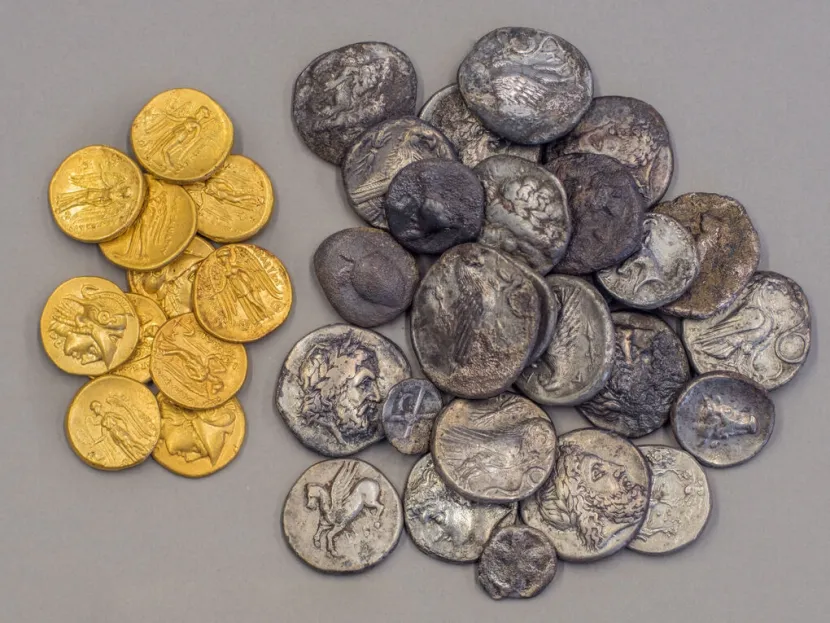
A unique treasure of 37 gold and silver coins brought to light by the excavation research conducted by the Ephorate of Antiquities of Chania under the direction of Maria Vlazaki, honorary general director of the Ministry of Culture, in Castelli of the old city, revealing additional valuable and rare evidence of the history of the famous palatial centre of Kydonia. Stored in a small clay vase, the 11 gold and 26 silver coins were found, which had been placed in two separate bundles, with the silver coins partially covering the gold ones.
«It is a unique coin set to date for Crete among the few treasures of similar composition of different precious metals, known in Greece of this period» notes the excavator, stressing that «it is a hoarding set with selected, high value coins for security in the unknown future and with the holder's preference for the strong international currency of the Hellenistic world».
Numerous coins in the second excavation
This rare treasure includes 11 gold staters of the type of Alexander the Great and his successors. Depicted, i.e., different versions of Alexander in life and mainly posthumous mintings in the name of Philip III Arridaios, Seleucus I Nikatoros and Lysimachus Thrace, the mints of Macedonia (Amphipolis), Asia (Abydos, Lampsakos, Sardis, Arados) etc. One gold stater corresponded to the monthly pay of a mercenary. The silver coins are 15 stateros of Helios, which were minted in Olympia during the Olympic Games of the 4th century BC, 2 dithrachms of Cyrene, 1 Corinthian stater of Anaktorion of Acarnania, as well as domestic Cretan dies, 1 stater of Praisos, 2 drachmas of Phaistos, 1 drachm of Yrtakina, 2 pseudo-Aegean half-drachms of Kydonia and 2 early issues of Aegina depicting the sea and land turtle. The date when the coins were hidden (terminus postquem) is around 300-280 BC.
It is impressive that this treasure, even more valuable as it includes gold coins, is the second treasure brought to light by Maria Vlazaki's excavation within the walls of the Acropolis of Kydonia. The first one was discovered in 2022 and consisted of 33 silver coins, which came from 13 cities of Crete and were kept in a cloth or leather pouch.
«The two treasures of Kydonia suggest the concealment of considerable sums, probably by mercenaries, in the open space behind the wall of the Acropolis of Kydonia due to an emergency at a critical historical phase of the city,» notes Maria Vlazaki.
Searching for the lost history of the city
For the excavator «most important of all is that the detailed study of the unique find will shed light on an unknown aspect of the history of the city at the end and first quarter of the 3rd century BC. With these excavations slowly, carefully and steadily the archaeological excavation is trying to read the ancient history of the city of Chania and fill in parts of the large gaps that are not covered by the written sources available to us.».
The coins are already in the Ephorate's conservation workshops at the Archaeological Museum of Chania for cleaning and conservation. The findings on the plot of land at 1 Katre Street, in Kastelli, in the old town of Chania, which M. Vlazaki has been systematically excavating since 2006, continue to surprise. There is gradually revealed the very large sub-style space-hall of the 14th century BC and belongs to the palatial complex of Cydonia of the Cretomycenaean period, which was destroyed by a powerful earthquake in the middle of the 13th century BC, resulting in the human sacrifice of the young girl, revealed by the excavator, and the sacrifice of large animals made by the Minoans to appease the chthonic deities. Along with the earthquake fault that was discovered in 2019 and the additional columns of the great hall found last year, the new findings reveal valuable fragments of this past.
During this year's investigation, which took place last October and November, the floor of the substrate was found to be mostly damaged and a small disturbed and distressed deposit of sheep and goat bones was also found, the remains of a meal similar to the one that had come to light in 2021 and had been associated with the foundation works of the public complex. This year, the northern part of the complex's wall was also uncovered, torn and opened by the violence of the earthquake.
Buildings of the Minoan era
This year's investigation continued, however, and in the «plot of land Lionakis-Vlamakis» on Kanevaro Street. «The results are particularly revealing in relation to the habitation at this point during the Minoan era» since parts of buildings of various architectural phases of the Minoan era came to light, on the floors of which were found 10 vases, mainly bowls, but also other utensils. At the same time it was verified that the part of the building with paved floors and internal brick walls that was discovered by Yannis Tzedaki in 1967 corresponds to other rooms in the west and northwest, where the kitchen that was excavated in 2021 also belongs. Red mortar decorated the walls of the formal rooms.
«After the research of 2023 we can state that the systematic excavation today offers the possibility of visiting and highlighting parts of all three periods of the Minoan palatial centre of Chania: the Paleo-Palatial (excavation of Lionakis / Vlamakis), the Neo-Palatial (St. Aikaterini Square and the excavation of Mathioudaki) and the final palatial or Creto-Mycenaean (excavation Katre 1)», notes Maria Vlazaki. «The excavation has been decisive in confirming that the dating of the complex that has come to light at this site dates back to the Early Palaeopalatial or Palaeopalatial Minoan period (1900-1700 BC). This element is an important fact for the archaeological site of Kastellios and its promotion», underlines, finally, the excavator and brings to mind the recent attempt to hotelize this area.