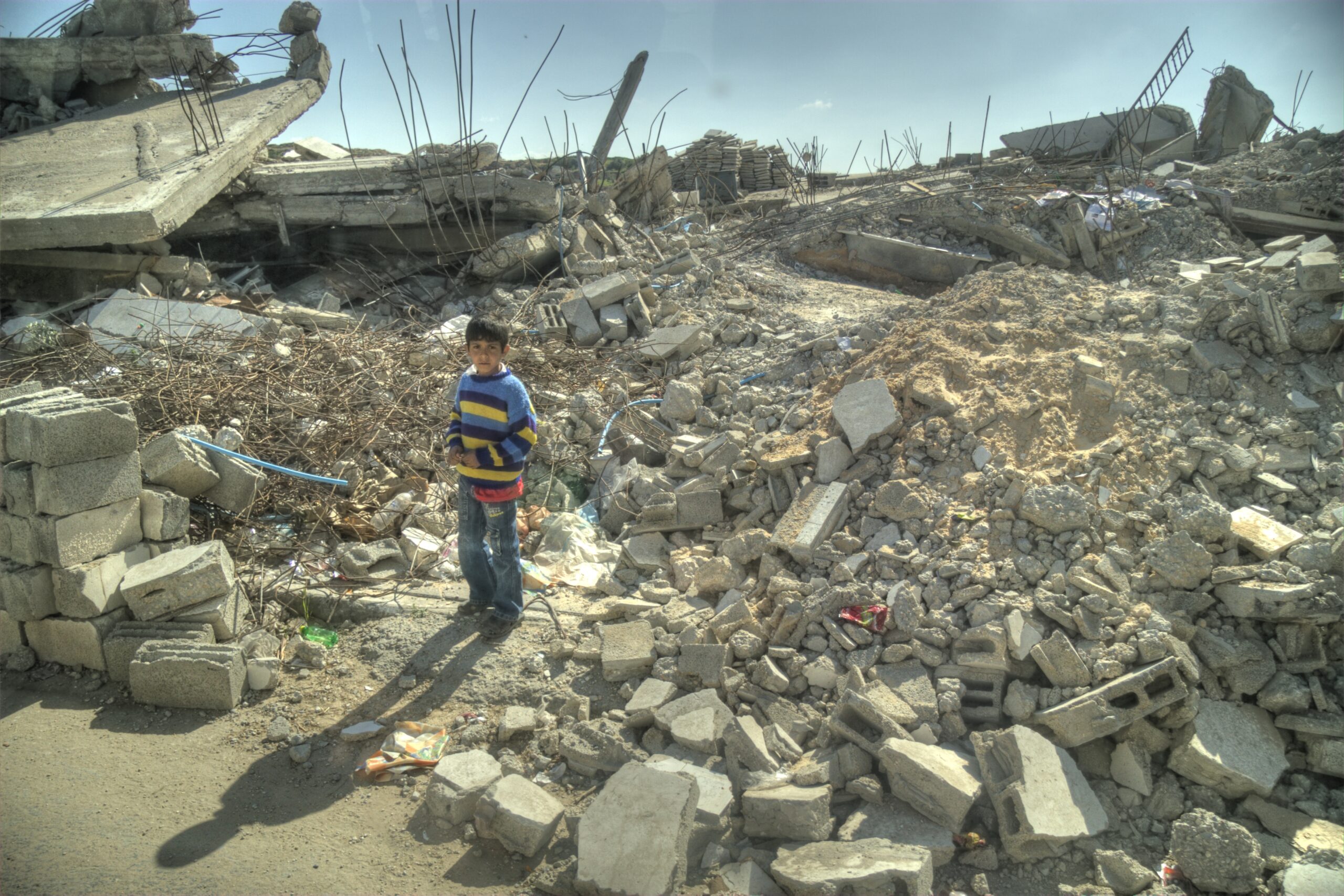
The Israeli armed forces continue to bomb the Gaza Strip today, while Washington has threatened, for the first time, to halt deliveries of weapons and ammunition to Israel in the event of a large-scale ground offensive in Rafah, as indirect negotiations in Cairo aimed at reaching a ceasefire agreement continued.
Shortly after midnight, a team from the French Press Agency reported that multiple artillery barrages had been launched in Rafah, in the area of the closed border between the Gaza Strip and Egypt. The Israeli army announced that it had also carried out airstrikes against «Hamas positions» in the central part of the enclave, which has suffered massive destruction after more than seven months of war.
Israeli Prime Minister Benjamin Netanyahu has long been threatening to order a large-scale ground offensive in Rafah, where, according to him, the ’last« units of Hamas’s military wing are hiding. However, 1.4 million Palestinians have also flocked to this city, the vast majority of whom have been displaced by the war.
In Washington, President Joe Biden acknowledged during an interview with CNN that «civilians have been killed in Gaza as a result of» U.S. bombs and, for the first time, set conditions for the continuation of U.S. military aid to Israel.
«If they enter Rafah, I will not hand over the weapons being used (...) against cities,» said Mr. Biden as the Israeli military reported that it is preparing a «limited» operation in Rafah, where the UN fears a «bloodbath.».
A senior U.S. official confirmed, on condition of anonymity, that deliveries were suspended last week «1,800 2,000-pound (907-kilogram) bombs and 1,700 500-pound (226-kilogram) bombs» to the Israeli military were suspended last week.
Earlier this week, the Israeli armed forces deployed tanks in Rafah and took control of the border crossing connecting the Gaza Strip with Egypt, thereby closing the most important entry point for convoys carrying humanitarian aid to the besieged Palestinian enclave.
The other crossing point near Rafah, Kerem Shalom, on the Israeli border with the Palestinian enclave, which was closed on Sunday following rocket fire for which Hamas claimed responsibility, was again targeted by rockets shortly after it reopened, according to the Israeli military.
«Constant» fire
On Wednesday, Israeli military forces continued their «targeted operations» on the Palestinian side of the crossing point in eastern Rafah, based on intelligence regarding «terrorists operating in the area.».
«Indiscriminate fire from Israeli artillery in eastern and central Rafah killed and wounded many people and struck the upper floors of apartment buildings,» Ahmed Radwan, a Civil Defense official in the enclave, told Agence France-Presse.
«We are very afraid. The occupying army continues to indiscriminately fire shells into neighborhoods in eastern Rafah, and airstrikes are also intensifying,» said Muhammad Ahmad Kista, a resident of the city. «Even areas that the Israeli army claims are safe are being bombed,» he added.
The closure of the crossings and the ongoing military operations in Rafah are heightening fears that the humanitarian crisis in the enclave will worsen even further.
As of yesterday, hospitals in the southern Gaza Strip had only «three days» worth of fuel« left, which means that »they may cease to function very soon,” warned the Director-General of the World Health Organization (WHO), Tedros Adhanom Ghebreyesus.
James Smith, a British intensive care physician on a mission to southern Gaza, spoke of a «catastrophic» health situation and the «pervasive» stench of sewage in hospitals that have suffered massive damage from the fighting and bombings.
This war broke out on October 7, when members of Hamas’s military wing launched an unprecedented raid from the Gaza Strip into southern areas of Israeli territory, during which 1,170 people lost their lives, the majority of them civilians, according to a report by Agence France-Presse based on official Israeli data.
Another 250 or more were abducted, of whom 128 remain in Gaza; however, 36 of the latter are believed to be dead, according to the Israeli military.
In retaliation, the Israeli army launched large-scale operations in the Gaza Strip, in which 34,844 people—the majority of them civilians—have lost their lives so far, according to the Hamas Ministry of Health.
«A »convergence” of views?;
In Cairo, indirect negotiations between Israel and Hamas—mediated by Qatar, Egypt, and the U.S., resumed yesterday morning in an effort to reach a compromise, secure a ceasefire, and prevent a large-scale attack on Rafah.
They were still ongoing last night, according to the media outlet Al-Kahera, which is believed to be affiliated with the Egyptian intelligence service. This source spoke of a «convergence» of views on certain points.
In Jerusalem, Benjamin Netanyahu met yesterday with CIA Director William Burns to discuss a possible «ceasefire» in southern Gaza in exchange for the release of hostages, an Israeli official said.
The day before yesterday, Monday, a few hours before Israeli troops were deployed in Rafah, Hamas announced that it had given the green light to the proposal submitted to it by the mediators.
According to statements by Khalil al-Hayya, the second-in-command of Hamas’s political wing in Gaza, the proposal consists of three phases, each lasting 42 hours: first, there will be a complete withdrawal of Israeli troops; then, the displaced will return to their homes; and finally, Israeli hostages in Gaza will be exchanged for Palestinian prisoners in Israel, with the ultimate goal of a «permanent ceasefire.».
The Israeli government responded that this proposal is «far from its demands,» reiterating that it opposes a permanent ceasefire as long as Hamas, which has been in power in the Gaza Strip since 2007, a movement designated as a terrorist organization by Israel itself, the U.S., and the EU, has not been «defeated.».
Israeli Prime Minister Netanyahu emphasized that he had instructed the Israeli delegation that left for Cairo to «insist on the necessary conditions» for the «release» of the hostages and for «Israel’s security.».
«Israel is not seriously interested in reaching an agreement,» said Izzat al-Risk, a member of Hamas’s political bureau, late last night, accusing Benjamin Netanyahu of actually seeking to «shift» the blame for the possible failure of the indirect negotiations onto Hamas, so that he can then «invade» Rafah.