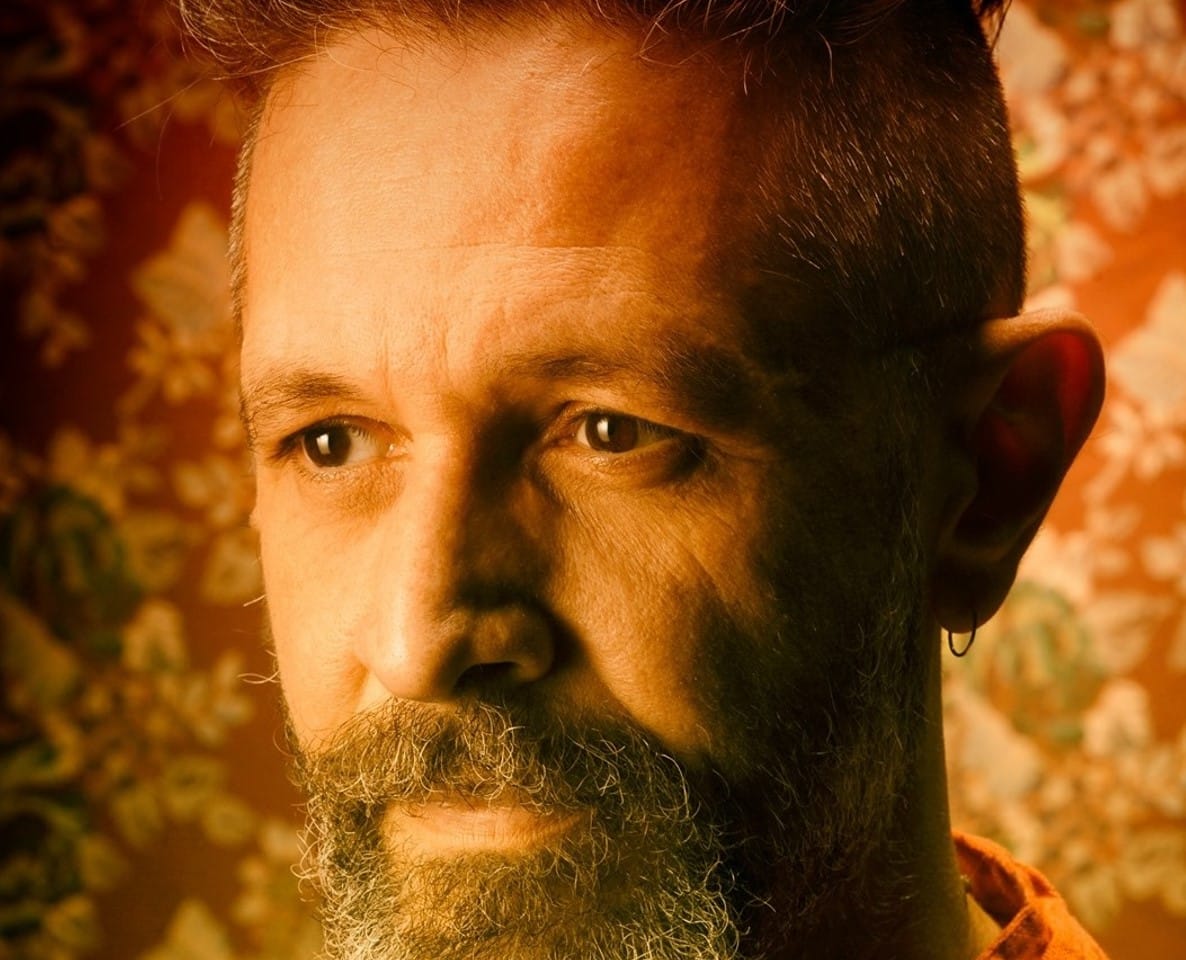
After a break to rest at the Kythera, the Emilios Cheilakis returned to Athens to play the role of Herodion, Thursday, August 26, and Friday, August 27, the role of Iago in the play «Othello». At some point in between, he spoke with the okmag.gr about the play he staged 15 years ago, his wife Athina Maximou, the role of women in modern society, and his return to television as Akylas Megaritis in «Wild Bees.».
When you’re on tour all over Greece and see so many places, you want to come back to one place to rest. Since every year, both Athena and I are on the road touring, we want to come back to a place where we can relax right away. We don’t want to go looking for the beauty of Skopelos, for example—which is also a very beautiful island—but we don’t have time to do that.
And why Kythira? What drew you to this place?;
So many things. Right now, neither of us really has that initial impression of Kythira anymore, because the past 18 years have shaped our experience. There are the friends we’ve had here for so many years, the house we live in, the way people are so calm around you without you having to explain anything to them. And because a place is made up not only of trees and rocks but also of people, the people we interact with here are very important.
This consistent choice of location means that Are you generally a person who sticks to a routine?;
Let's agree on something: especially when you're really tired, what helps you relax is a routine. Athena and I never stop working—especially with the kind of work we do and the shows we put on. The level of difficulty is extremely high, and the frequency with which we work is truly at its peak. This creates a need for us to rest completely when we do take a break. We don’t want to go somewhere to relax by doing new things; all we want to do is stick to our routine. We exhaust our creativity and our desire for discovery at work.
It's so sweet of you to include her in the your responses.
But it’s not a matter of sweetness. As a person, I am Aimilios Cheilakis, who is with Athina Maximou. That famous aspect of love—its possessiveness—in the right circumstances means wanting to belong to the other person. In the wrong circumstances—and this is what has led to everything we’ve been experiencing lately—it means thinking that the other person belongs to you. Almost as if we'd agreed with Athena, we want to belong to each other.
The element of wonder is What is important for a couple who have been together for so many years?;
It’s the only way for people to stay together, whether in their professional or personal lives. Even among friends, there has to be admiration—either for them or for you. I admire my best friends from school. They’re two people who have truly made it in life on their own, and I generally admire self-made people. My best friends, Kostas and Apostolos, and I have been friends since 1985.
But this shouldn’t become a matter of routine. Because when you’re constantly doing the same things—as we were saying earlier—there are times when the word “routine” takes on a negative connotation. No, repetition is the mother of learning, for starters. And the more you repeat things, the more you come to understand your world. Also, people aren’t all the same. Every time, you get to know each other all over again, and that's the key to relationships. When people stay the same, it’s boring, but neither my best friends nor my wife nor I have been the same people in recent years. We’ve shed our old selves many times over; we’re not the same people, and we’re constantly getting to know each other all over again. And that’s what always keeps us together.
Was returning to the theater after such a long hiatus ultimately a way to relax?;
I mentioned this again at some point. In fact, we needed «physical therapy» because all our limbs and tools had become stiff from inactivity. The way we read, the way we speak, the way we move. We had to take another look at the things we’d taken for granted because of the continuous, cyclical way we worked. When this long hiatus occurred, we realized that we had to reacquaint ourselves with who we are and with our tools. Actors—at least the ones I admire—have toolkits full of ways to help us hear the story. What we’re doing—especially now after this long hiatus—is remembering not why we became actors, but why we continue to be actors. And believe me, the reason we continue is very important. The reason is fundamental: we tell you stories, and you need them. And this past summer, we realized that the audience was even more «thirsty» to see a performance than we, the professionals, were to put one on.
And that was so wonderful: stepping out onto the stage and being enveloped by the audience’s silence because they’re expecting something important from you. What matters isn’t Myrto Alikaki, Yannis Bezos, or Aimilios Cheilakis. What matters is *Othello* which will continue to be performed for the remaining 418 years, and each time, we actors have the «sacred» duty to tell you the story, so that you may hear it once again. We actors are the pillars—that is, the supports—of a bond that connects the person who first conceived the idea with the person who continues to think about it. This is Art.
This work remains incredibly relevant. Even though it was written many years ago, we continue to grapple with the same issues, such as violence and racism. Why don’t we humans ever learn? Shouldn’t we have eradicated certain things by now?;
Lockdowns and pandemics happen once every 100 years. Events of this magnitude will lead to massive outbreaks. I think history will record the events of COVID-19 and the global lockdown in very dark letters. I find myself wondering about other things. Why did we handle this situation so poorly on a global scale, when it could have been managed very wisely?. We didn't manage the pandemic with people in mind, but based on derivatives. We managed the pandemic from an economic standpoint. Yes, of course we had to manage it economically, but we forgot about the people. Beyond the numbers—and who will receive financial aid—these are people who have vulnerabilities, psychological problems, or psychological triggers—which is wrong—and often these lead to very violent outcomes.
I am in favor of the term «femicide» because the weakest member of a family is usually the woman. «Weak» due to the structure of our society. Women are constantly burdened with the responsibility of household chores. Women, or wives, still do not hold the position they should in Greek society—and, I believe, in Western society as a whole. We still view women solely as mothers. There are people who marry women because they want to have children. This is extremely fascist. You are essentially reducing a person's role to nothing more than their reproductive capacity. We forget that the people we live with and talk to every day are people who have basic needs that extend to the level of psychological needs, like hearing «I love you’ from their partner. I think the most important thing is to tell your partner or friend every day that you care about them and that you love them. When that happens, there are people who will be there for one another. All those men who killed their wives—essentially because they were female— because they were unable to assume the role of a man, or because men believed their wives belonged to them— all these crimes that were committed were magnified as a »necessity«—if there is such a thing as a necessity to commit a crime—due to the pandemic and lockdown. Because no one in the world properly addressed the fact that we are social beings, herd animals, beings who will follow a natural leader and want to be together to share a common purpose. When all of that is lost, grave crimes will follow.
The things we’ve seen in works like *Othello*—why haven’t we, as a society, come to terms with them, and why do we continue, for example, to be Racists?;
Homo sapiens has existed for the past 250,000 years. So our species is still quite young compared to all the other species in the world. They’ve been around for millions of years. What am I trying to say?; As a species, we are still in a state of decline, and we are not helping nature move forward; eventually, it will cause our extinction. I think that the way we perceive our «being»—and this is where art seeks to help—is not aggressive but rather an attempt at imposition. Asserting yourself is the easy way. «Attack is the best form of defense,» some people used to say. But enforcing order requires people who are capable of managing it. Of course, not everyone there has the knowledge to manage how to enforce order, and sometimes order must be enforced. Look at what happened to the all-powerful United States: within a week of withdrawing from its occupation of Afghanistan, everything that had been built—albeit on a “house of cards”—collapsed. Let us not expect that human beings are beings who possess more than collective memory—and a repository of that memory that they guard like the apple of their eye. That is why we keep making the same mistakes, because even though we have art, literature, and history to teach us from our mistakes, the span of our lives—which is far too short—makes us forget far too quickly. That’s why things repeat themselves every two or three generations. Nothing will change. I think this is like a natural phenomenon. It has less to do with the human mind and more to do with human nature, and we are omnivorous mammals. That says it all.
What is it about *Othello* that fascinates you? Why did you choose to play Iago rather than the main character?;
I had played the lead role in 2006 in a production by the New World Theater, with Gerasimos Genatas as Iago at the time, Athina Maximou played Desdemona, Konstantinos Papachronis played Cassio, and Kora Karvounis played Emilia. It was a wonderful cast. Fifteen years ago, I had worked on the play using the same translation by Kapsalis. The role I’d always envied was that of Iago, and so when the time came, I suggested to Yiannis that we put on this production. And I told him, «Yiannis, you’ll play Othello and I’ll play Iago,» with one fundamental goal: to talk about the tragedy of the outsider, not the tragedy of jealousy. Giannis, because he is a political being—first and foremost, Giannis is a political being, and only then an actor—immediately understood the need to talk about what’s different. One remarkable thing about Giannis Antetokounmpo is that he never saw himself the way others saw him. He never saw himself as «a black guy selling CDs.» He saw a strong person who could achieve anything—and he did. Isn’t it amazing that such a talented kid said from a young age that he wanted to go to the NBA? I imagine that all the bigots in Sepolia and Kolonos would have seen «that scum,» «the illegal immigrant selling CDs.» Othello was always the “scum,” the black man, the outsider, the foreigner, the “other.” He was everything they didn’t want, yet they needed him because he was a great general. This is the tragedy of the man who considers himself an outsider; it is what has always fascinated me about “Othello.” It is clearly the citizen’s place within his state, and not just the emotional aspect—that a man is being taken for a fool. Othello is already a man poised to be taken for a fool by the slanderous words and thoughts imposed on him by Iago, who is, for me—ever since and through Shakespeare’s eyes— the modern European. The one who, after the Enlightenment and the Renaissance, was the man who wanted his neighbor’s goat to die rather than have one of his own. This is the modern European—let’s not get confused by technological achievements. If you look at an ordinary European banker, you’ll see that this is exactly what he is. Remember Dijsselbloem—he’s a Iago. He may be a respectable gentleman in a suit, but he was a man who wanted certain countries to suffer economic ruin because that would be his life.. Iago is Deutsche Bank. (Laughs.)