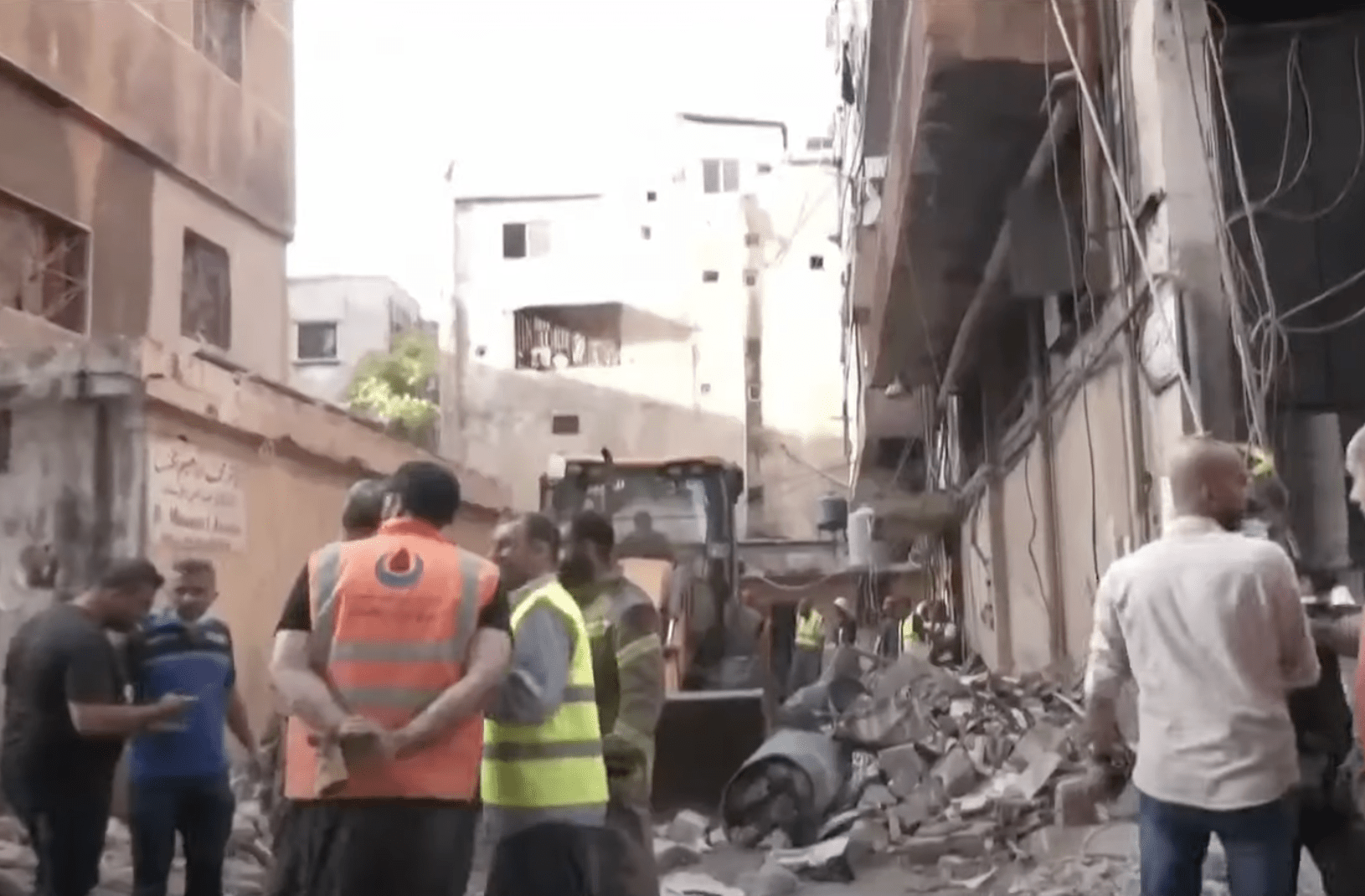
For the third consecutive day, Israel is continuing today, Wednesday (9/25) its relentless aerial bombardment of southern Lebanon, which has so far claimed the lives of hundreds of people. At the same time, Hezbollah announced that it fired a missile targeting the Mossad headquarters near Tel Aviv, which, it says, is responsible for the assassination of leaders and the detonation of suicide bombers and wireless devices.
«Starting at 5:00 a.m. (local time and Greek time), enemy warplanes launched strikes» against various areas of southern Lebanon, according to the Lebanese National News Agency (NNA), which added that there were casualties but did not specify the number.
«The Islamic Resistance launched a Qader 1 ballistic missile at 6:30 a.m. (local time and Greek time) on Wednesday (…) targeting the Mossad headquarters in a suburb of Tel Aviv,» Hezbollah announced.
Warning sirens were heard today in Tel Aviv as Israel's air defense system intercepted a surface-to-surface missile, which was detected entering Israeli airspace from Lebanon, the Israeli military noted. No casualties or damage were reported, and according to the Israeli armed forces, there has been no change in civil defense guidelines.
Meanwhile, Hezbollah announced the death of one of its senior officials in an attack in a southern suburb of Beirut, at a time when the international community is trying to prevent the entire region from erupting into conflict.
After Gaza and the occupied West Bank, Lebanon has now become an «active front», the head of the United Nations Relief and Works Agency for Palestinian Refugees (UNRWA) emphasized during an interview with AFP Philippe Lazarini, referring to «triple tragedy».
The Security Council The United Nations has been convened for an emergency session today, Wednesday, at 6:00 p.m. New York time (at 1:00 a.m. tomorrow, Thursday, Greek time), to discuss the escalation of the crisis, at France’s request.
The intense, deadly bombings of the past few days have driven people onto the streets hundreds of thousands of Lebanese citizens who are fleeing from the south in every direction. Meanwhile, early today, the Israeli Air Force struck a «warehouse» in Saadiyat, a coastal town about 20 kilometers south of the capital, according to a source close to the Lebanese security forces cited by Agence France-Presse.
In a statement it released to the public, Hezbollah confirmed the death of «Commander Ibrahim Muhammad Kubaisi», who «was killed on the road to Jerusalem,» to use the phrase generally employed by the movement when referring to those killed by Israeli fire.
Earlier, the Israeli armed forces reported that «Air Force fighter jets eliminated Ibrahim Mohammed Kubaisi, commander of the missile and rocket network of the terrorist organization Hezbollah.».
According to the Israeli military, «at least two» other commanders of the units coordinated by Ibrahim Kubaisi were killed in this strike — which, according to the Lebanese Ministry of Health, left at least 6 dead and 15 wounded.
Hezbollah fired «about 300 rockets» at Israel in retaliation, «wounding six civilians and soldiers, most of them slightly,» according to the Israeli Defense Forces.
For its part, the Shiite Lebanese movement claimed responsibility for 18 attacks against Israeli territory, including the firing of 90 rockets at the headquarters of the Israeli Army’s Northern Command, near Safed, as well as the launch of one-way drones against a naval base in southern Haifa, the major port of northern Israel.
«We will continue to strike at Hezbollah. And I say to the people of Lebanon: our war is not directed against you; it is against Hezbollah,» said the Israeli prime minister. Benjamin Netanyahu in a video released by his office.
Israel has «no desire» to invade Lebanese territory, and would prefer a diplomatic solution to end its conflict with Hezbollah, said Israeli Ambassador to the UN Danny Danon, noting that the purpose of the operations is to allow the tens of thousands of residents of northern Israel—who have been forced to flee their homes due to the virtually daily exchangesthat are now approaching a year.
«Lebanon is on the brink of the abyss»
Concerns about the rapid escalation of hostilities between Israel and Hezbollah, an ally of the Palestinian Islamist movement Hamas, dominated the opening of the UN General Assembly in New York.
«Lebanon is on the brink of the abyss,» the UN Secretary-General warned once again from the podium Antonio Guterres.
On Monday, the heaviest bombardments launched by Israel since October 8, 2023, swept through southern and eastern Lebanon, killing at least 558 people, including 50 children and 94 women, and wounding another 1,835, according to Lebanese health authorities. This is the highest single-day death toll since the end of the Lebanese Civil War (1975–1990).
According to the Israeli military, 1,600 «targets»—Hezbollah positions—in southern Lebanon and the Bekaa Valley (to the east), another stronghold of the movement aligned with Tehran.
The number of Lebanese citizens who have become internally displaced is now approaching 500,000 following the escalation of Israel’s bombing campaign against Hezbollah this week, the country’s Foreign Minister, Abdallah Bou Habib, said yesterday at an event organized by the Carnegie Endowment for International Peace on the sidelines of the UN General Assembly.
According to the UN, tens of thousands of people have fled to Saida, the largest city in the south, to Beirut, or to Syria.
«We didn't even know where the bombings were coming from»
Zeinab Diab, 32 years old, who, like hundreds of other families, took refuge in a school that had been converted into a reception and accommodation center for internally displaced persons near the capital, said that her village, near the border, which she fled with her husband and four children, «was practically destroyed.» «We didn’t even know where the bombings were coming from. It’s as if there’s even more brutality this time,» she said.
Schools and universities will remain closed through the end of the week throughout Lebanon. Many airlines have suspended their flights to and from Beirut.
Late Tuesday night, Britain announced that it is sending some 700 of its troops to Cyprus, to prepare for potential emergency evacuation operations of British nationals from Lebanon.
In mid-September, Israel announced that the «center of gravity» of the war it is waging was shifting from the Gaza Strip to the north, officially stating that its «goal» as ensuring the return of tens of thousands of its residents to their homes «in complete safety.».
Hezbollah, for its part, vows to continue striking Israel «until the end of the offensive in Gaza,» where the war that broke out in October of last year is now in its 355th day.
The intense bombardments followed heavy blows against Hezbollah last week — a series of explosions involving communication devices rigged with explosives on September 17 and 18, which left 39 dead and hundreds injured, and then, on September 20, the Israeli bombing in southern Beirut that claimed the lives of 55 people and decimated the leadership of the elite Radwan unit, including its commander, Ibrahim Akil.
Addressing the General Assembly, Joe Biden warned against a «full-scale war» in Lebanon and stated that it is time to «finalize now» a ceasefire agreement in the Gaza Strip between the Israeli government and Hamas.
Other leaders condemned Israel’s actions in Gaza and Lebanon. The Emir of Qatar, Sheikh Tamim bin Hamad al-Thani, referring to the war in the besieged small Palestinian enclave of 2.4 million residents, spoke of the «crime of genocide.».
Iranian President Masoud Pezeskian met Tuesday evening with his French counterpart, Emmanuel Macron—who called on him to support «general de-escalation» in the Middle East—on the sidelines of the General Assembly. Earlier, he described via X the UN’s «inaction» toward Israel as «incomprehensible» and stressed to CNN that Hezbollah cannot be «left alone» in the conflict with Israel.
According to Israeli political analyst Michael Horowitz, both sides are aware of the risks that a full-scale war would entail. The situation is «extremely dangerous,» but there is «still room for diplomacy,» he said in an interview with Agence France-Presse.