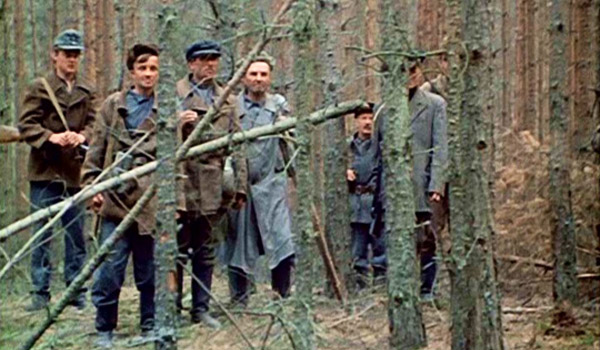
The film follows a 12-year-old boy, Floria (played exemplarily by Alexei Kravchenko). When he unearths a lost gun, Floria joins the Russian army, eager to live as a soldier. However, his fantasy is quickly shattered when he is confronted with reality. His fellow soldiers leave him behind to protect him and he is left alone. He meets Glasa (Olga Mironova), a beautiful teenager who is also left alone. Together they return to Floria's village, where they discover that all the inhabitants and Floria's family have been slaughtered. Floria continues wandering and embarks on a new mission: to find food for the helpless inhabitants of a neighboring village. Along the way, he finds himself in the middle of a massacre and sees the Nazis pile the villagers into a warehouse and set it on fire, wiping out along with it Floria's innocence, which is visibly beginning to age. As he faces the unspeakable tragedy, his hair turns white and wrinkles appear on his face.
Just as Coppola wrote poetry through brutality, Malik applied Mozart to the lyricism of his landscapes, and Eisenstein entangled film in the gears of propaganda, so too does Elem Klimov describe the saga of the Nazis' inexhaustible brutality through stunning realistic compositions, without directing a dull, realistic anti-war film. His images are unforgettable, the changes in the film's mood countless, and the child's odyssey through the devastated landscape a collective testimony in its entirety, and together a film that was the pinnacle without continuity of the rebirth of fuzzy, impetuous post-Soviet perestroika cinema. Requiem for a Massacre, as it is titled in French, is a great film, on a par with the best of the genre.
THODORIS KOUTSOGIANNOPOULOS
Elem Klimov (1933-2003)
Elem Klimov was born in Stalingrad on 9 July 1933 and died on 26 October 2003. He was a film director during the last two decades of the Soviet State. Klimov managed to make only 5 feature films during his career, the last one, «Come to See», is one of the world's most shocking anti-war films.
Western audiences became familiar with Klimov mainly through his late works, especially «Agoniia» («Rasputin», 1975, distributed in 1984) and «Idi i smotri» («Come and See», 1985). Both are historical films, the first about Grigory Rasputin, the sensationalist advisor to Tsar Nicholas II, and the second about the Nazi atrocities in Belarus in 1943.
Klimov put an end to his career for many reasons. The rapidly changing political scene in Russia and the consequences for the cultural sector affected Klimov, who had been appointed first secretary of the Union of Soviet Directors in 1986. The old guard was replaced by a new one. Klimov had run into problems with the directors brought up by Gorbachev's Perestroika. Klimov had failed in his attempts
to establish a new and dynamic cinema along the lines of the great Soviet Cinema. Known as he was for his ideological convictions, he resigned his post two years later.
He never completed his plan to make a film based on «The Master and Margarita», Mikhail Bulgakov's fictional satire, nor his adaptation of Dostoevsky's novel «The Possessed». He stated: «I have lost interest in films.
I feel I have done everything possible to make it happen.»
Klimov had another deep wound. His wife, Larissa Shepatko, was killed in 1979 in a car accident during the filming of her movie Farewell. A week after her death, Klimov himself was completing the filming of the movie. The Klimov-Sepitko pair had fascinated during the 1960s, both sharing Russian irony, black humour and introspection. They graduated from VGIK, the Higher State Film School, at a time when filmmakers were shifting from social realism to a more personal drama, searching for the role of the individual in modern society.
Born into a family of communists - his name is an acronym for Engels, Lenin and Marx - Elem Klimov graduated from the Higher Air Force Academy in 1957. He took up journalism and then joined VGIK; after graduation, in 1964 he made his first film, Dobro pozhlovat«, ili postoronnim vkhod vospreshchen (’Welcome or No Trespassing», 1964), a satirical film about a rambunctious child who is expelled from camp by the authoritarian director. «The Adventures of the Dentist» (1965) was his second film
and this one is satirical.
«Come and See», his fifth and final film, is a gripping epic of Nazi atrocities in Belarus during World War II. The film follows twelve-year-old Floria, who ages throughout the film as he is constantly confronted with brutality, his hair turns white and wrinkles appear on his face. The screenplay is by Adamovich, who had served in World War II and experienced the devastating horrors left by the Nazis in Belarus, and cites real events, such as the destruction of the village of Katyn. Klimov also drew on material from his childhood, when he was forced to evacuate the town in a boat with his mother and infant brother during the Battle of Stalingrad. ’The flames were rising to the sky, even the river was burning (Volga). It was night, bombs were exploding everywhere and mothers were trying to cover their children's eyes with whatever they had at their disposal. I included everything I knew in the film, even though I hadn't seen anything.’ This film was Klimov's swan song and his personal testimony.
Statement by Sean Penn on the film
«A few years ago my father called me and told me to drop whatever I was doing and go to the University of California, Los Angeles (UCLA): a department had scheduled a screening of a Russian film by a director named Klimov and I couldn't miss it.
Veteran of over 36 missions in Berlin during
of World War II, my father was never an avid fan of films about the war, resenting either the inaccuracies or the tendency to romanticize the battles. That film was COME AND SEE, an excellent anti-war film.
I'm glad I got there that day,
BECAUSE WHAT I SAW WILL BE ETCHED IN MY MIND FOREVER.
IT IS A MASTERPIECE NOT ONLY FOR CINEMA BUT FOR ALL HUMANITY»
IDI I SMOTRI / COME AND SEE
CATEGORY: Dramatic
YEAR OF PRODUCTION: 1985
COUNTRY OF PRODUCTION: Soviet Union
DURATION: 142
COLOUR: EARLY.
Directed by Elem Klimov
They star: Alexei Kravchenko, Olga Mironova
Watch other movies on our site http://cinema.mosfilm.ru/
Subscribe to our Youtube-channel and follow us on social networks!
Facebook: https://www.facebook.com/MosfilmOfficial
VK: https://vk.com/club20286388
Instagram: https://www.instagram.com/mosfilm_off...
The restoration of the film was made by a team of professionals from the Mosfilm Computer Graphics Group. Learn more https://cg.mosfilm.ru
The film tells about the tragedy of the Belarusian villagers during the Second World War.
The Great Patriotic War, 1943. Belarus is occupied by the Germans. Sixteen-year-old boy Fleura decides to go to the guerrillas. There he meets the girl Glasha. This film shows the tragedy of a child during the war like no other. Glasha is a young girl, she has just started to grow up, she wants to like boys, she dreams of beautiful dresses and bright beads to be attractive and manicured. And Glasha - in the woods, in the war - wears a light airy dress, understanding all the absurdity of what is happening and thus challenging the terrible reality. And Fleura is a child at the beginning of the picture. In the end, having gone through a childish horror and fear, the teenager becomes an adult, frighteningly adult - his face is distorted by old wrinkles, and in the soul there is no place for love ...
By decision of a special jury, the picture restored by Mosfilm was awarded the VENICE CLASSICS AWARD FOR BEST RESTORED FILM (For the best restored film in the section “Venetian Classics”) The film competed with masterpieces of world cinema, including works by Michelangelo Antonioni, Bernardo Bertolucci, Milos Forman, Stephen Spielberg, Jean-Luc Godard, Marco Ferreri and other prominent directors.
Directed by: Klimov Elem
Writers: Adamovich Alexander, Klimov Elem
Composer: Yanchenko Oleg
Operator: Alexey Rodionov
Art director: Petrov Viktor
Actors: Lautsevicius Lubomiras, Berda Alexander, Kravchenko Alexey, Mironova Olga, Bagdonas Vladas, Lumiste Jurs, Lorenz Victor, Rabecki Casimir, Tilicheev Evgeny, Vasilyev Victor, Domrachev V.