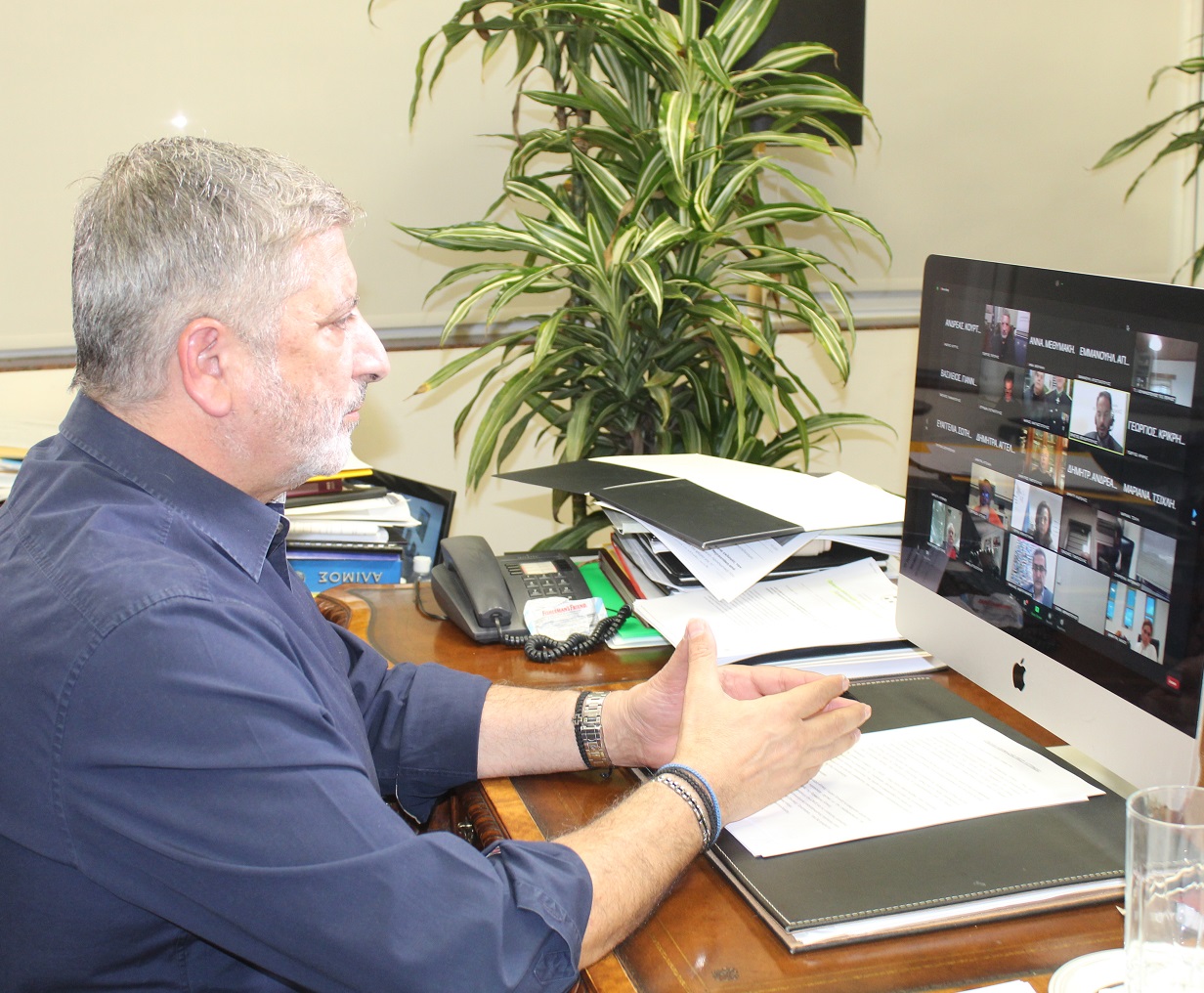
With a sense of responsibility toward the citizens of Attica and a firm belief that the Regional Authority did everything in its power to address the consequences of the extreme weather events—unprecedented in both intensity and scope— extreme weather events caused by Storm ELPIDA, Attica Regional Governor George Patoulis presented today to the Attica Regional Council (PESY) a report on the actions taken to manage the situation.
The priority is to bring the truth to light
As the Regional Governor of Attica emphasized, «Our goal is not pointless confrontation, but rather to bring the truth to light and achieve the broadest possible consensus, in our ongoing effort to protect the prestige of the institution we serve, to improve the effectiveness of our mechanisms, and to be truly useful to the citizens of Attica. However, we are determined to fight to the end against those who try to paint white as black and systematically tell lies. I have said this in the past, and I will say it again now. We will not compromise with populism or those who serve it. We do not want to sugarcoat the situation, nor do we want to claim that everything went well. Our goal is:
First, let’s tell the truth and debunk the lies that have been circulating all these days—lies that not only do us an injustice but also insult us.
Second, we need to highlight all the positive aspects of our initiatives. Because not enough attention has been given to all the positive actions we have implemented as a Region, which have helped mitigate the negative effects of the severe weather.
Third, we want today’s discussion to serve as an opportunity to agree on what needs to be done moving forward. After all, the goal cannot be merely to offer criticism, but also to put forward positive proposals for the future.
And finally, I want to avoid letting our discussion at PESY turn into a partisan confrontation, because I consider it a disgrace to democracy itself, that the management of weather events, instead of being a field for creative cooperation, is turned into petty partisan squabbling.
Many people told a lot of lies about the Attica Region’s efforts
From the day the entire government apparatus, led by the Ministry of Climate Change and Civil Protection, began managing the “ELPIDA” storm, the Region of Attica has been subjected to unfair and unjustified attacks regarding the way it managed this phenomenon within the scope of its responsibilities. We suddenly found ourselves having to apologize for the mistakes and omissions of others, just as the mayors of Attica have found themselves in exactly the same position all these days; with very limited resources and staff at their disposal, were called upon to manage a very difficult situation.
The Attica Region is one of the many links in the Civil Protection chain. It does not constitute Civil Protection on its own. It has clear responsibilities and authorities, and based on these, we have taken action in recent days. We have gone beyond these limits solely to assist the municipalities by providing them with equipment and personnel so that they, too, can fulfill their responsibilities.
Because we believe that the Regional Authority and the municipalities in Attica must always work together, hand in hand—through good times and bad.
The most severe storm in recent years
The situation we faced was truly difficult. We were hit by extremely severe weather, a snowstorm according to the National Meteorological Service, which was characterized not only by its intensity but also by the vast area it covered. It spread across nearly the entire Athens Basin, which meant we had to take action along the entire length of the road network under our jurisdiction. This is a factor that sets it apart from other similar events.
The question that arose was whether we were ready to face it. Whether we had made sure to stock up on salt and whether we had the necessary resources to fight it.
The 8 Truths About the Attica Region's Action Plan
The truth is the only powerful response to those who resort to lies and populism and unfairly target the Attica Region to cover up their own shortcomings, or to reap short-sighted partisan gains.
We respond to these lies with 8 truths.
First Truth, once again, the current administration of the Attica Region has handled a very difficult situation—a catastrophic natural disaster—, without a single human life being lost. We achieved our first and most important goal: to protect the lives of every fellow citizen in our area of responsibility who was facing severe weather. We also succeeded in keeping the roads open to the 10 major hospitals in Attica as well as to the National Ambulance Service (EKAV). Meanwhile, dozens of our fellow citizens were transported to healthcare facilities via the Attica Region’s emergency hotline, 1110.
Second Truth, the Attica Region’s emergency response system was on full alert long before the severe weather struck. We were not caught off guard, and throughout our shift we remained at our posts, ready to act in accordance with the plan that had been established in advance.
Third Truth. Once again, the value of prevention has been demonstrated, as opposed to dealing with extreme events after the fact. In areas where the Attica Region had jurisdiction over school operations, we took timely and effective action. The Region of Attica, in exercising its authority, made the right decision to keep schools closed on Monday, January 24. It was a decision that everyone, without exception, agreed played a decisive role in mitigating the negative effects of the severe weather and ensuring that the lives of young children were not put at risk.
Fourth Truth. The Region of Attica on the morning of the 24thof As of January, it had 164 vehicles at its disposal, 107 of which were snow-clearing vehicles of various types. We had no shortage of resources to fight this battle. From January 21, when our services were mobilized, through January 28, when snow removal operations were still underway, we had the necessary equipment at our disposal every day. When the heavy snowfall began on January 26, we had a total of 241 pieces of construction equipment, 118 of which were snow-removal vehicles. All of these machines were made available to us through a fully lawful and transparent process, as required by current legislation. .
The Fourth Truth, the Region of Attica had a sufficient supply of deicing salt, in anticipation not only of the “ELPIDA” storm but also the storms that preceded it and brought snowfall to major roads in the mountainous areas under our jurisdiction—situations that were handled with complete success.
Specifically, there were more than 5000 metric tons of salt on January 21, at the Kapandriti Warehouse, the Oinoi Warehouse, and at eight temporary storage sites in selected locations throughout Attica, in order to facilitate the loading of salt onto snow-removal vehicles. According to data provided by the relevant agencies, a total of 5,500 metric tons of salt had been used by January 30. Of this amount, 1,500 metric tons were distributed to the municipalities.
Sixth Truth. The Region of Attica fought hard to fulfill its responsibility to clear snow from 1,500 kilometers of road. That was our responsibility. And we fulfilled that responsibility to the greatest extent possible, given the severity of the severe weather.
- More than 90% of the road routes under our jurisdiction were already passable by the evening of the first day of the bad weather without the need for snow chains, with a focus on the mainmain roads in Athens, such as L. Syggrou, Kifissias, Poseidonos, Vouliagmenis, Vari-Koropi, Lavrio, Athens, and the New Athens-Corinth National Highway.
- On the morning of the following day, nearly all major roads (including one lane of Mesogeion Avenue) were passable, as snow removal operations had continued throughout the night at full speed. On Mesogeion Avenue, the presence of cars on both the right and left sides of the roadway hindered our efforts to clear the snow and open the entire road from the start.
- Our decision to close schools in Attica on the day of the severe weather played a decisive role in the plan’s success and in preventing far more unpleasant situations. Otherwise, the even heavier traffic on the one hand and the prevailing panic on the other would have made it impossible for snowplows to operate, creating particularly difficult conditions with unpredictable consequences.
- We would like to emphasize that only a section of L. Alimos–Karea–Katechaki and Marathon Avenue remained closed by order of the Traffic Police due to slippery road conditions, and until noon on the second day of the bad weather, due to the presence of stranded vehicles. The vehicles were removed after the Traffic Police located and notified their owners using license plate information.
- As mentioned earlier, there was an abundance of de-icing salt. On the first day of the bad weather, the snowplows, which were working in tandem with snow removal operations, also spread de-icing salt to prevent the formation of a layer of ice. It should be noted that at specific points on the road network where problems occurred, this was caused by the accumulation of a large volume of snow due to the severity of the storm and not by the presence of ice; therefore, the situation would not have been affected in any way, regardless of whether de-icingor not.
What didn't work out the way we wanted
One might reasonably ask, since we planned everything correctly, what went wrong and why so many problems arose.
A series of decisions made without the Attica Region’s input created situations that, in the end, proved to be detrimental to our efforts. Specifically, we cite the following main reasons:
- First of all, the closure of Nea Odos by the traffic police near Kalyftaki starting at 8 a.m. for heavy vehicles and vehicles without chains created additional traffic congestion that was diverted to Kifissias Avenue, Pentelis Avenue, Karea/Katechaki Avenue, and Mesogeion Avenue via Attiki Odos.
- The majority of traffic from Attiki Odos, which was closed, was diverted to the Geraka–Anthousa and Marathon/Mesogeion exits. As a result, extreme traffic congestion developed on Marathonos Avenue and Mesogeion Avenue (exits 14 and 15).
- The order issued at 12:00 to close public services was followed by the overwhelming majority of private sector employees as well, resulting in extreme traffic congestion throughout the road network, even though there was no inclement weather.
- The Traffic Police ordered that access to Katechaki Avenue in the uphill direction be blocked starting at 2 p.m. On the downhill section, the exit near Niovi Street Square was also blocked due to a stalled truck belonging to the Municipality of Ilioupoli.
- The fact that vehicles without snow chains entered Mesogeion and Alimos-Katechaki Avenues in the midst of heavy snowfall and snow accumulation Mesogeion and Alimos-Katechaki, causing them to become immobilized and further hindering the movement of snowplows. Many of these vehicles were abandoned, effectively blocking nearly all traffic lanes.
As the Region of Attica, we will not allow ourselves to be made the convenient scapegoat for any problems that have arisen. We will not claim that everything went according to our plan, but neither will we shoulder responsibilities that do not fall to us. On the contrary, we will hold others accountable for the wrong decisions that were made and that made our work more difficult.
Seventh Truth: The Region of Attica stood by the municipalities that asked for our help. Without taking into account the mayors’ party affiliations, as some have falsely claimed. Since January 26, we have provided 50 pieces of construction equipment to 21 municipalities. Similarly, we have provided 1,500 metric tons of salt since January 26 to 27 municipalities that requested it.
Eighth Truth, We have a plan for what needs to be done starting tomorrow, so that similar situations do not happen again. .
In contrast to those who criticize our actions and our work without offering comprehensive proposals for improving the civil protection system in the future, the current Administration of the Attica Region:
- It has presented its positions regarding the need to revise the existing civil protection plan, emphasizing regional management, as part of the ongoing reform of the state’s operational model.
- He has requested that each region of the country be allocated the necessary funds through the Recovery Fund to acquire the appropriate resources and equipment to strengthen the civil protection system.
- It is seeking the ability to hire additional staff, so that we can proceed with the necessary staffing of this specific department, as well as a new institutional framework for volunteer groups, which we want to integrate into our system. .
In addition, as the Region of Attica, we are moving forward with the following.
- Effective February 15, 2022, the four-digit number 1544 for the road network of the Attica Region. Through this number and a mobile app that will be developed, citizens will be able to either call or send geotagged photos to a 24-hour center located at the Traffic Management Center. In the event of a traffic jam, this number will provide immediate support and information to drivers, informing them of the estimated time until the traffic clears (this will help reduce the number of vehicles abandoned by their drivers). It should be noted that a large number of the Traffic Control Center’s surveillance cameras were taken out of service either due to power outages or due to the accumulation of snow and ice within their field of view.
- We are moving on to the mandatory use GPS on a single platform to provide a real-time display of the location of every type of construction machinery used for snow removal (through contractors or the civil protection registry). The GPS imagery will be transmitted to the screens and mobile phones of the Regional Governor, the Deputy Regional Governor for Civil Protection, the district and thematic deputy, as well as to specific officials of the Attica Region who have been designated as responsible under the comprehensive plan for winter road network maintenance projects and actions
- A general coordinator will be appointed immediately by the Region of Attica, with responsibilities for overall coordination in cooperation with the relevant agencies, e.g., the Ministry of Civil Protection and Climate Change, the Ministry of Citizen Protection, the Ministry of Infrastructure, the Hellenic Police, the Fire Department, concession companies, municipal coordinators, OASA, DEI, ADMIE, DEDDIE, EYDAP, EKAB, etc., and the oversight of the activities of the regional coordinators.
- The local coordinators (e.g., the rural Deputy Regional Governors) will head a team based in the relevant Subregion and consisting of a designated official from the Region of Attica (as specified in the snow removal plan) and the foremen of the contractors operating in that
- We promote the function as a unified coordinating body for the Attica Region and the Attica Traffic Police, based at THEPEK. Live footage will be transmitted from the locations of snowplows and construction equipment so that, in the event these vehicles encounter difficulties moving, a Traffic Police or Rapid Response patrol car can intervene immediately. Although road closures fall under the exclusive jurisdiction of the Traffic Police, decisions regarding them should be made in consultation with the Region of Attica.
- We will introduce mobile snow-removal stations, which will consist, depending on the circumstances and the area of operation, of :
- a) specialized 4x4 vehicles equipped with hand tools and a sufficient supply of salt, as well as at least 5 workers to respond to situations requiring manual snow removal(e.g., extricating vehicles) on high-priority road corridors as designated in the snow removal plan previously established in accordance with the General Secretariat for Civil Protection’s guidelines
- b) 1 small snowplow and 1 vehicle transport platform: Bobcat-type vehicles with a plow blade or 4x4 vehicles to respond to traffic congestion when large snowplows cannot move (e.g., extricating vehicles) on high-priority road corridors as designated in the snow removal plan previously established in accordance with the General Secretariat for Civil Protection’s guidelines
- c) Appropriate snow-removal equipment (3.5-metric-ton loader with a blade) and a sufficient supply of salt at key locations such as: hospitals on call, the National Ambulance Service (EKAV), military bases, nursing homes, institutions, etc.
The civil protection plan needs to be revised
The Region of Attica, like all regional authorities in the country, supports a radically new strategic plan for Civil Protection, with a substantial role for local government, as dictated by internationally recognized best practices, which have yielded exceptionally positive results for the safety of citizens’ lives and property.
It is time for a new approach, based on a decentralized model, with clear responsibilities for each involved entity, supported by the central government through the provision of additional resources, infrastructure, resources, and personnel to local governments, to meet the needs of society.
Local government is a key pillar of the state’s effective functioning, and we cannot tolerate the downgrading of its role or allow it to be used as a scapegoat over time—even for responsibilities that do not belong to it.
In response to the discussion at the Attica Regional Council regarding the management of ELPIDA, Attica Regional Governor George Patoulis stated:
«We have certainly learned a great deal from the recent crisis. With these eight truths, we are responding to the lies and unfair criticism we have faced in recent days. We consider it absolutely necessary that the Prime Minister’s commitment be put into action soon; with great and unprecedented courage, not only apologized to the citizens but also acknowledged the need to create a better and more effective mechanism, with improved operational coordination and cooperation among all relevant agencies, more resources and personnel, so that the next severe weather event will find us better prepared and more effective. We endorse this need, and as Regional Governor of Attica, I am ready to contribute to the national effort, in a spirit of honesty and equality. After all, this is in the best interest of the citizens, to whose service I am politically, institutionally, and morally committed.» .
It should be noted that tDozens of mayors and hospital administrators expressed their gratitude to the Region and the Regional Governor personally for their assistance in managing the severe weather in letters they sent.