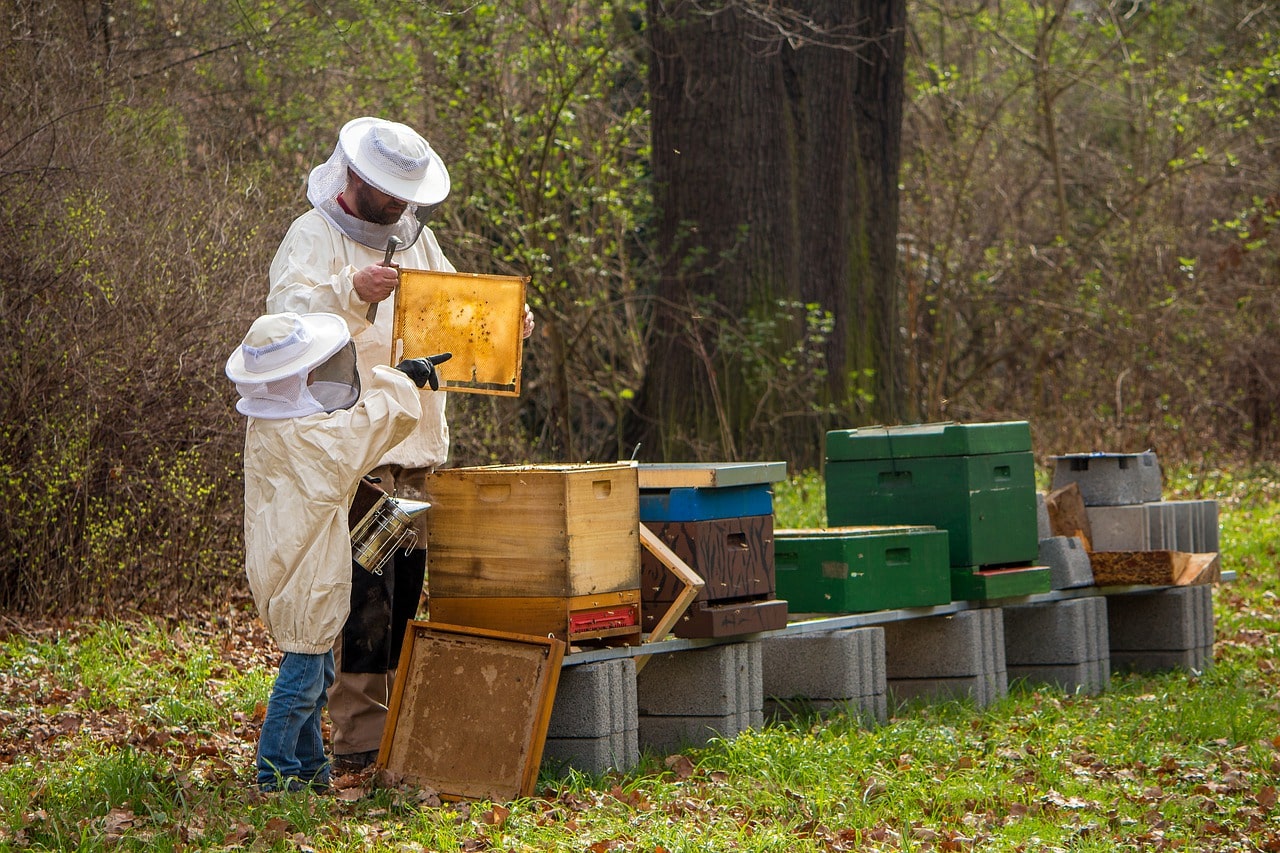
An innovative platform that will provide timely warnings to help avoid a range of stressors and situations directly related to both the social life of the bee as well as the quality of the products they produce, is being developed as part of the «SMARTBEEing» research project led by the Apiculture Laboratory at Aristotle University of Thessaloniki.
This was announced by Chrysoula Tananaki, Associate Professor at the Laboratory of Apiculture and Sericulture, Department of Agriculture, Aristotle University of Thessaloniki, who is scheduled to speak at noon today (at 12:50 p.m. according to the schedule) is expected to speak at the 9th Panhellenic Conference being held at the Thessaloniki International Exhibition Center. The two-day conference, themed «New Technologies as a Catalyst for Sustainable Agricultural Development,» concludes today and is co-organized, as part of the 29th Agrotica, TIF-Helexpo and the Department of Agriculture, School of Agriculture, Forestry, and Natural Environment at Aristotle University of Thessaloniki.
At the Aristotle University of Thessaloniki’s Apiculture Laboratory, as part of two research programs, new technologies and innovative systems to modernize the management of bee colonies.
According to Ms. Tananaki, the goal of SMARTBEEing is to study factors affecting bee welfare and improve beekeeping productivity through the use of advanced information and communication technologies.
As part of the project, the installation of the aforementioned platform is being designed, developed, and implemented on a pilot basis, specifically, data on bee behavior in the field is being collected based on hive sounds, while predictive models are being developed to help beekeepers receive early warnings of conditions within the hive, such as an impending swarm, the loss of the queen, food consumption, and the diagnosis of diseases.
As part of the second «SmartBeeKeep» research program, cutting-edge technological advancements are being leveraged to benefit the beekeeping sector as well as the study of biodiversity. The project’s main objectives are the application of new GIS and machine learning technologies, to develop and provide online tools that will be used to identify and map beekeeping flora, for predicting flowering, for the botanical identification and traceability of beekeeping products, and for the management of bee colonies.
According to Ms. Tananaki, beekeeping is a particularly dynamic sector of Greek agricultural production. The 22,000 Greek beekeepers own approximately 1.5 million hives, and Greece ranks eighth in honey production on the European continent.
Of course, as she herself notes, «although beekeeping has a long history, the unique nature of the honeybee, combined with the lack of stationary apiaries, has only allowed for the integration of new technologiesin the practice of beekeeping.» Most of the systems currently in use are limited to monitoring hive temperature and weight or protecting the apiary from theft.
Interest is growing in biostimulants as a new technology for promoting plant growth
The use of biostimulants is gaining increasing attention as a modern agricultural practice for enhancing the vigor and yield of cultivated plants, as pressure to limit the use of chemically synthesized fertilizers continues to mount, notes Professor Aikaterini Manoli of the Department of Agriculture at Aristotle University of Thessaloniki (AUTH).
«Currently, the market share of biostimulants in EU countries stands at $1 billion and is steadily expanding, with an average annual growth rate of 10–12%,» she notes in her presentation, which she is expected to deliver later today (at 1:20 p.m. according to the schedule), at the 9th Pan-Hellenic Conference being held at the Thessaloniki International Exhibition Center. The two-day conference, themed «New Technologies as a Lever for Sustainable Agricultural Development,» which concludes today, is co-organized as part of the 29th Agrotica by TIF-Helexpo and the Department of Agriculture, School of Agriculture, Forestry, and Natural Environment at Aristotle University of Thessaloniki.
Biostimulants are defined as individual substances, mixtures, and materials which, when applied to plants, seeds, soil, or other growing media, affect the physiological processes and metabolism of plants, thereby enhancing their growth and vigor, without themselves constituting nutrients for the plant.
According to her, the EU has already recognized bio-stimulants as a separate category of fertilizer products in a relevant regulation that took effect in July 2022.The European regulation distinguishes between two subcategories: bio-stimulants containing microorganisms and bio-stimulants without microorganisms, while provisions are established to harmonize the rules governing the placing of these products on the market in individual member states.
According to the European regulation, the characteristics of plants on which biostimulants act—and for which they must be evaluated—relate to nutrient use efficiency, crop quality characteristics, tolerance to abiotic stress conditions, and the availability of limiting nutrients in the soil and rhizosphere. «At the Agricultural Chemistry Laboratory of the Department of Agriculture at Aristotle University of Thessaloniki, experiments are being conducted to test the effects of biostimulants on both microorganisms and other materials,» she emphasizes in her presentation.
It also notes that, according to the results so far, biostimulants have been found to increase the content of chlorophyll and other biomolecules in plant tissues, enhance photosynthesis and water use efficiency, redox homeostasis, and plant metabolism, enabling them to grow more vigorously and respond better to conditions of high salinity and drought.
In this context, she notes in her presentation that it is of great interest to continue experimenting with new materials and their mechanisms of action under stress conditions. Furthermore, she argues that research is needed on the impact of these products on crop yields, the cost-effectiveness of their application for producers, and their impact on the environmental footprint of crops.
Innovative Techniques in Natural Resource and Energy Management Are Under Discussion
Innovative techniques in natural resource and energy management, the adoption and implementation of which will contribute significantly to achieving the goals of the Green Deal, while benefiting producers and ensuring an adequate food supply for consumers, speakers explained at the 9th Pan-Hellenic Conference being held at the Thessaloniki International Exhibition Center. The two-day conference, themed «New Technologies as a Lever for Sustainable Agricultural Development,» opened yesterday and is being co-organized as part of the 29th Agrotica by TIF-Helexpo and the Department of Agriculture, School of Agriculture, Forestry, and Natural Environment at Aristotle University of Thessaloniki.
In his speech, Professor Stavros Vougioukas of the Department of Biological and Agricultural Engineering at the University of California, Davis, USA, in his speech. .
As he pointed out, the continuous growth of the global population, along with its purchasing power and per capita consumption, creates a need for much more food, animal feed, plant fibers, and biofuels.
Given that the aforementioned equation must be solved in an economically and environmentally sustainable manner, Mr. Vougioukas emphasized that «the application of robotic technology in agriculture contributes significantly to achieving this goal, as it enables precision agriculture even at the level of an individual plant or organ.».
According to him, agricultural robots can also «alleviate» existing and impending labor shortages, either by increasing the productivity and safety of existing workers or by replacing them in low-skilled, labor-intensive tasks, such as weeding or harvesting fruits and vegetables.
Artificial Intelligence and Its Contribution to Precision Agriculture
In precision agriculture, which effectively combines artificial intelligence tools by integrating diverse sensors with intelligent algorithms, which are specifically trained to identify, distinguish, or predict a variety of critical situations affecting the entire spectrum of the primary sector, lies the solution for farmers to adapt to the climate crisis while simultaneously reducing their environmental footprint. This is highlighted in a study by an assistant professor and a professor in the Department of Agriculture, School of Agriculture, Forestry, and Natural Environment, Aristotle University of Thessaloniki (AUTH)—Xanthoula Irini Pantazi and Dimitrios Moschos, respectively—which was presented at the conference.
In terms of crop monitoring, according to the study, artificial intelligence tools enable successful supervised and unsupervised analysis of data from optical sensors and are considered «critical» for precise spraying and decision-making, due to their effectiveness in both identifying and assessing the spatial distribution of biotic and abiotic crop stresses, as well as their high performance in monitoring crop health.
With regard to the level of quality and authenticity assessment for PDO foods, the paper points out that intelligent algorithms are appropriately trained to detect food adulteration, providing timely alerts to decision-support systems.
Furthermore, artificial intelligence, «strengthens and ensures trust between producers and consumers by developing smart applications that allow consumers to track the progress of the product being produced, as well as the conditions of harvesting, storage, and preservation in real time using simple devices such as a cell phone.».
Furthermore, artificial intelligence techniques are effectively applied to sustainable land management, specifically the effective management of soils where high concentrations of heavy metals are found, through the development of tailored services using open, interconnected data, thereby contributing to decision-making for sustainable and climate-resilient agroecosystems.
Useful Tools for Food Security
The study concludes that continuous advancements in Earth observation and geoinformatics technologies offer opportunities to provide higher-quality services and improved decision-making, with the ultimate goal of strengthening food security at the global and local levels, is the conclusion of a paper presented at today’s conference. The paper was authored by Thomas Alexandridis, Ines Cherif, Nikolaos Karapetsas, Dimitris Kasampalis, Thomas Koutsos, Georgios Bilas, Ioannis Navrozidis, and Georgios Ovakoglou from the Laboratory of Remote Sensing, Spectroscopy, and GIS, the Laboratory of Applied Soil Science, Division of Land Improvement, Soil Science, and Agricultural Engineering, Department of Agriculture, Aristotle University of Thessaloniki.
At a time when food security is being undermined worldwide due to climate change, soil degradation, and the depletion of water resources, phenomena that lead to reduced production, it is the proper management of agricultural resources that can minimize the consequences for crops and the impact on the environment.
One of the tools available for the proper management of agricultural resources is satellite Earth observation, which, as noted in the paper, offers the ability to monitor large areas at minimal cost compared to field surveys.
Earth observation using unmanned aerial vehicles (UAVs) and sensors mounted on farm tractors provides detailed information for diagnosing biotic and abiotic stresses, and in mapping variations within the field for precision agriculture applications.
Geoinformatics contributes to the processing and further utilization of geographic data collected through the aforementioned methods, as well as to its distribution to users via the Internet or apps on smart devices.
Examples of the application of the above technologies in the context of collaborative research programs include the following:
- Detection of Stress in Olive Trees in Chalkidiki Using Satellite Images
*Forecasting rice production in Chalastra by combining production growth models and satellite imagery
*Use of spatial autocorrelation of corn production data in Argentina to define management zones for precision agriculture applications
*Monitoring of the water surface in South Africa using satellite imagery
*Analysis of land suitability for corn cultivation in China as a tool for evaluating agricultural practices and cropping systems aimed at soil improvement.
"Green" livestock buildings are the only way forward
«The technical solutions that can make a decisive contribution toward the creation of green livestock buildings—»which is the only way forward to meet the challenges of the future,” were presented in his presentation at the conference by Thomas Kotsopoulos, professor and director of the Laboratory of Agricultural Structures and Equipment in the Department of Agriculture at Aristotle University of Thessaloniki.
Environmental protection, climate change mitigation, the Green Deal’s requirement to reduce greenhouse gas emissions by at least 55% by 2030, and the transition to a climate-neutral society – economy by 2050, «make it imperative that all economic activities align with this direction, and agricultural production cannot be exempt,» he pointed out.
He noted that the agricultural sector accounts for approximately 10% of greenhouse gas emissions, with the majority of these emissions coming from livestock farming. In this context, he noted that livestock farming must significantly reduce greenhouse gas emissions and, in conjunction with the implementation of the circular economy model, become climate-neutral by 2050. The solutions adopted should be farmer-friendly, easy to implement, and cost-effective.
In light of the above, the laboratory focuses on the study and research of integrated solutions aimed at achieving climate-neutral animal production. These include: monitoring and regulating the animals’ living environment, the use of passive solar systems to conserve energy in livestock buildings, and the use of precision livestock farming to implement personalized nutrition for production animals andcircular economy systems, such as the production of energy and fertilizers from animal waste.