
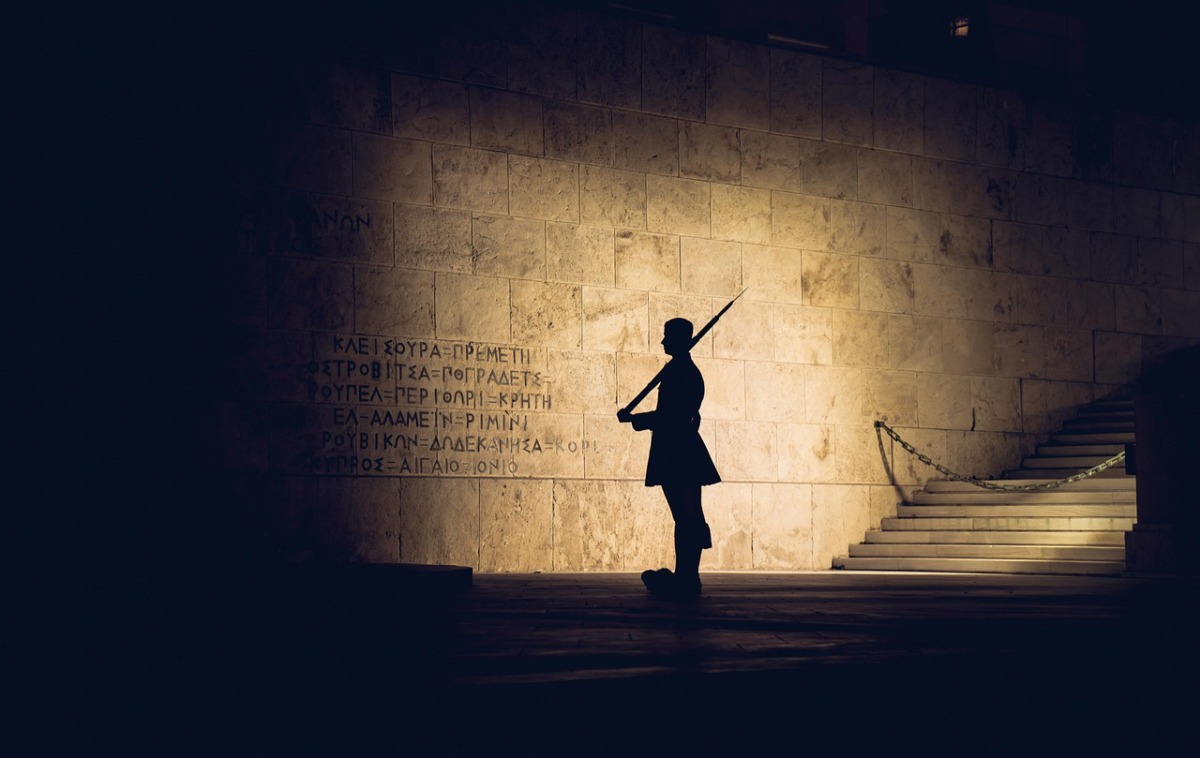
-Is there any parallel between 1821 and today?;
-Or, then, how should a revolution be judged based on current information?;
-Were Kolokotronis and the other rebels of 1821 on the «right side of history» at that time?;
-Was it «realistic» and in line with the «interests of the Greeks» for them to revolt (those who did revolt, since there were also those who «submitted») and take up arms against the then-all-powerful Ottoman Empire?;
-Was it realistic for them to ignore the balance of power at the time and take on the region’s «bully»?;
-Was it «smart» to champion freedom, justice, independence, or even the principles of the French Revolution and the European Enlightenment?;
There are many questions, and the answers aren't always easy. Let's start from the beginning:
-According to Wikipedia, «the origins of the Greek national movement that led to the Revolution can be traced to the mature phase of the Modern Greek Enlightenment.».
-In 1821, the Greeks (though not all of them…) rose up against Ottoman rule. Their opponent was an empire, and their allies were justice and «enlightened Europe.» The revolution did not take place with the balance of power in mind. If that had been the case, no one would have risen up! The revolutionaries of 1821 did not side with the powerful; they fought for principles and ideals.
-Today we find ourselves in a different era: Supporters of Trumpism tell us that the «right side of history» is to side with whoever can provide us with «protection»… Of course, it’s surreal for those who ignore the fact that Cyprus’s 40% is occupied by Turkey—a NATO member—to talk about «protection»…
-If we want to draw parallels, today the figures embodying the «Kolokotronis spirit» are Spanish Prime Minister Pedro Sánchez, Brazilian President Lula da Silva, Danish Prime Minister Mette Frederiksen, Mexican President Claudia Sheinbaum, and others.
What is their common characteristic? They claim and strive to exercise their authority by invoking international law, national interests, humanitarianism, solidarity, and concern for human life. It is not easy, nor does it always yield results. There are many examples of leaders with some of these characteristics who were simply overthrown, not always by legitimate means (e.g., the leftist Salvador Allende in Chile or the conservative Mohammad Mossadegh in Iran). They simply «happened» to challenge the interests of large corporations… Mossadegh nationalized Iran’s oil (and was overthrown by the U.S. and the United Kingdom), Allende nationalized the major copper companies (and was overthrown by General Pinochet with U.S. support).
The question is: How—if at all—can a leader combine power with legitimacy and the principles of the European Enlightenment? And since no leader can do anything alone, can a small nation, or a «small» state, act autonomously, free from dependencies, guided by what is in the best interest of its citizens and the country—rather than by what the powerful allow?;
On the other hand, of course, there are certain spineless leaders who find it hard to say «no» to Trump… We won’t name names or offend anyone’s sensibilities, but you get the idea…
Today, the U.S. president is somewhat reminiscent of Clemens Wenzel Lothar von Metternich (1773–1859, a prince by title and one of the most famous diplomats and politicians of the Austrian Empire). At the Congress of Vienna in 1814, Ioannis Kapodistrias took the floor and said that it was the duty of kings to ensure the liberation of the Greeks from the Ottoman yoke. Metternich interrupted him and, in a condescending tone, replied that Europe knew nothing of the Greeks. It knows the Ottoman Empire, under whose authority the «so-called Greeks» find themselves…
Donald Trump behaves in a similar manner today. He insults anyone who dares to say even a timid «no» to him and threatens the weakest (he gets along just fine with those who have nuclear weapons)… Today, authoritarian leaders rely on the law of the strong rather than the strength of the law. When asked why they kill, why they wage wars, why they exploit the weakest nations, the answer is «because they can»…
The question is: what are we going to do? Some of those who, in a few days, will be delivering celebratory speeches about the 1821 revolution are, at the same time, calling on us to be realistic and not to take on the powerful who «protect us»…
I look forward to hearing how they assess the uprising of small Greece—which had been under occupation for 400 years—against the then-all-powerful Ottoman Empire… Shouldn’t they have refrained from rebelling because «it wasn’t realistic»?;
-I’m waiting to see how they’ll interpret Kolokotronis’s words, «fire and axe to the submissive.» The Old Man of Moria was referring to the Greeks who preferred safe submission to the Sultan over the risk of revolution!
-I’m waiting to hear how they assess the solidarity shown by the philhellenes who came to fight and died alongside the Greek revolutionaries. Did they do the right thing, or should they have «stayed on the sidelines»?;
And to cut a long story short: Andreas Kalvos, in his 1826 «Ode to Freedom,» wrote the famous line, «Freedom requires virtue and courage.» Because freedom is simply not granted; it requires morality (virtue) and courage (boldness) to be achieved and maintained. It is a timeless symbol of the struggle for independence, often associated with the Greek Revolution of 1821.
So, those who wish to distort our history and our origins once again should not test us. We know our history, and we are capable of critical thinking.
All revolutions and social struggles have been directed against those in power. Those who «preach» the right of the powerful are out of step with the times and with the European acquis. So let those who advocate submission to the more powerful—or at the very least, not opposing their unlawful aims—refrain from pointing fingers. That was never the meaning of March 25…
Author of the article:

Journalist, member of ESIEA, member of the Board of Directors of R/S Athens 984











Yiannis, you told me EVERYTHING.
The thing is, people like you—who are still resisting, among your own kind—are a species on the verge of EXTINCTION………..