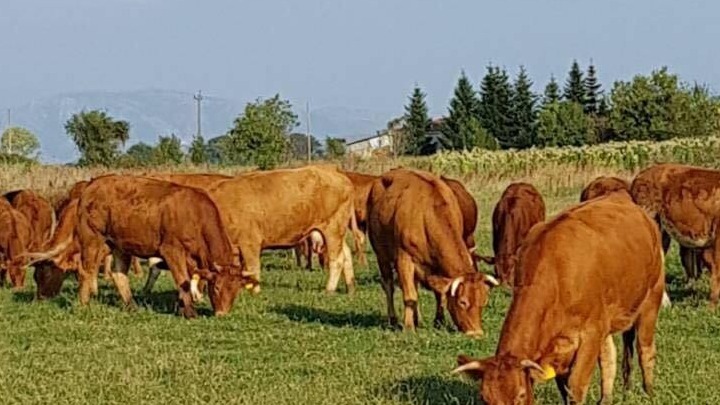
During the summer months, they take their flocks and move on foot to an altitude of over 800 metres, to Grammos in Kastoria, to Pieria from Kozani and from the Florina side, to Kristallopigi. They have chosen to live in the countryside, and although they have to be on duty 365 days a year, often absent from important moments in their personal lives, they are categorically reluctant to move to the cities. These are the modern shepherds and businessmen, many of them under 40 years old, who raise free grazing animals of the Greek red breed in the pastures of Western Macedonia.
«It is no coincidence that traders from Egypt and Israel have already come to the stand of the Agricultural Cooperative of Cereals and Livestock Products of Kastoria at Zootechnia and asked us to supply them with cattle of the Greek red breed», says its president, Dimitris Moschos, speaking to APE-MPA. Saying, however, that at this stage «all the animals we have are sold before they are born», he clarifies that «only the Egyptian trader asked us to send him 15,000 calves per year. At the moment we do not have them».
The partnership in numbers and its award
The Agricultural Cooperative of Cereals and Livestock Products of Kastoria was founded in 1914 and today consists of 85 farmers, who raise a total of more than 5,500 animals. The main activity of the cooperative is the production of red meat, i.e. veal, by rearing free grazing animals in the pastures of Western Macedonia.
«The Greek red breed is adapted to the geographical terrain of the region and is characterized by hardiness and longevity,» Mr Moschos says. Annually, the aforementioned cooperative produces 4,700 purebred calves of the Greek red breed and according to him, «many of them are sold before they are even born». The association also produces another 1 200 animals of other breeds which are not certified.
Greek farmers, with their activity, protect the environment, so that natural firebreaks are maintained, according to him, who notes that «in the last 20 years where these animals graze, there has been no fire».
In this context, he underlined the daily battle that the Greek breeders of the cooperative in the pastures of Western Macedonia and their persistence and perseverance in pure blood and high quality, recalling that «our efforts were rewarded when our cooperative received the 1st place, among 100 nominations, in a European competition and in the category «Resilient future» with the nomination «Genetic resources in livestock farming: Greek red breed of Kastoria - Krystallopigi».
Where else is the Greek red breed bred - What do breeders need?;
The Greek Red breed, recognized in our country since 2011, is not only bred in Western Macedonia, but also in areas of Thessaly, Epirus and Macedonia. The Agricultural Cooperative of Cereals & Livestock Products of Kastoria, together with five other cooperatives, Pancerraikos, ETHEAΣ of Thessaloniki, Komotini, Drama and Grevena, is participating in a programme for the development of isolated areas. The six cooperatives breed the Greek red breed of cattle, with the participation of 363 livestock holdings and a total number of 24 118 cattle of the Greek red breed.
In the framework of the programme, which is expected to end this year after a short extension, there is an attempt - among other things - to genetically improve the cattle of the Greek red breed «in order to ensure the highest quality characteristics», Mr Moschos notes, and a database is being created «to safeguard the sector and the breed», he stresses, adding that the pedigree is also being built.
In order for the breeding of Greek red breed cattle to continue unhindered, Mr Moschos notes that the support of the state is required. What breeders of this breed need is: subsidies for replacement calves, support for production costs that have risen sharply due to rising energy and feed prices, and to be given priority in the Improvement Plans and more points.
At the same time, they call for the establishment of an educational programme and continuous training of farmers on the use of new technologies, «so that they can really take advantage of the new technologies and innovations that are now offered throughout the entire chain of farming and thus be able to bring it to measures, reducing their own production costs», Mr Moschos stresses.
In the framework of Zootechnia, an event «Greek red breed of Kastoria Krystallopigi: From the mountain pastures of Western Macedonia to your plate». The event was addressed by the Deputy Minister of Rural Development and Food, George Stylios, who said, among other things, that with the Improvement Plans, the announcement of which is expected in March, people in the primary sector will be able to purchase equipment and thus move from mechanical agriculture and animal husbandry to intelligent or precision agriculture.
El. Alexiadou