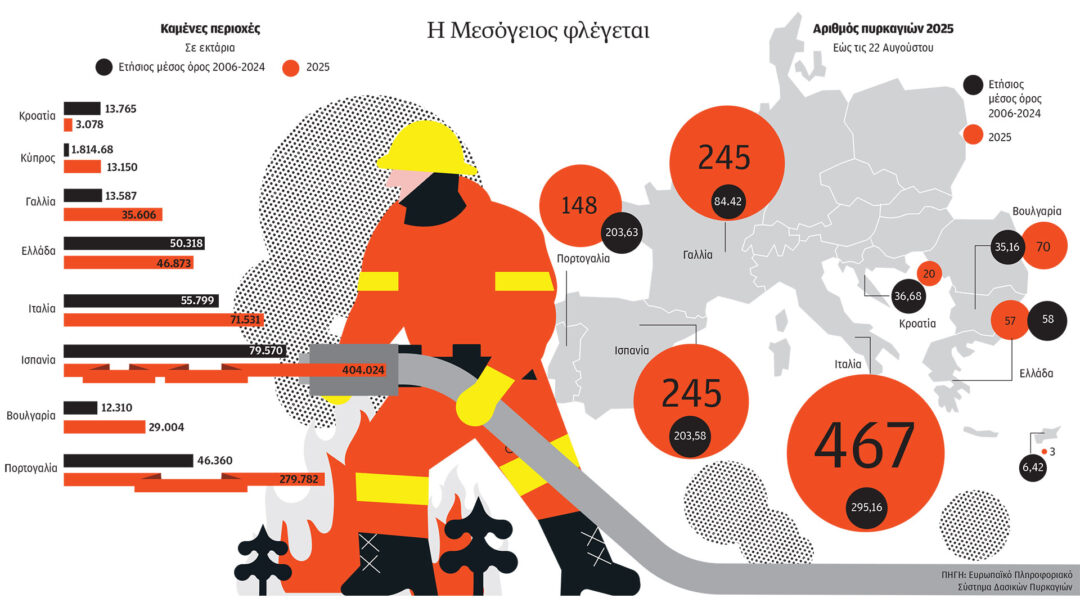
The area that has already burned this year in the European Union is four times the average for the past 20 years (2006–2024). According to satellite estimates from the program Copernicus, the summer of 2025 is so far the most devastating.
The countries of southern Europe have been disproportionately affected. The massive wildfires that broke out in July and August in Greece, Cyprus, Spain, and Portugal have consumed thousands of stremmata, killed people and animals, and destroyed property.
The pattern has been repeating itself in recent years: citizens throughout southern Europe feel vulnerable to a new threat, one that bares its fangs more and more fiercely every summer. Every failed attempt at prevention or timely firefighting is followed by a political crisis. Citizens demand the resignations of those in charge, accusing them of inefficiency, and governments shift the blame to the climate crisis, while trying to avoid the political cost by pointing to one another’s disasters as a «consolation.».
Whose fault is it?;
Are all of us Southern countries at the mercy of the sweeping effects of the climate crisis, or are we all making the same critical mistakes by failing to adapt to the new circumstances?;
"Probably the latter," concludes the Paulo Fernandes, a Portuguese professor of forestry and an expert on large wildfires, whose development he has been studying on a pan-European level for the past 30 years.
Major wildfires – This is the first time such large wildfires (burning more than 100,000 stremmata) in an area that extends beyond the borders of a single country, stretching from central Portugal to northern Spain. This has never happened before.
«Governments simply react, are running after the disaster. I believe this is a very serious problem in Europe: there is a reaction, but no prevention. They are simply trying to their public image, announcing additional measures and the purchase of more helicopters, arresting arsonists, and tightening the legal framework regarding arson.
All of these are reactionary policies that in no way they don't “get to the root” of the problem», the scientist remarked. Dr. Fernández has published dozens of scientific articles on wildfires and served as the organization's scientific coordinator CoLab forestwise, which conducts research on the relationship between forests and fire.
As he explained, the countries of the South must adapt to the unprecedented conditions observed in recent summers. «This is the first time that such large fires (editor’s note: fires burning more than 100,000 stremmata) have broken out simultaneously in an area that extends beyond the borders of a single country, stretching from central Portugal to northern Spain. This has never happened before.».
This phenomenon is part of a trend observed in the Mediterranean over the past few summers, during which fires have become increasingly larger and more destructive. In fact, he noted that while the number of fires is decreasing, the areas burned are increasing: «95% of the burned area is caused by 10–20 fires. The remaining 5% is caused by the other hundreds.» According to him, the causes lie in the climate crisis, changes in the landscape—primarily due to socioeconomic conditions—and fire management policies.
Drought and Winds
«We are experiencing prolonged periods of drought, combined with strong winds. Warmer days with lower humidity, as well as temperature changes at different altitudes in the atmosphere, which, specifically in these types of widespread fires, play a significant role in causing human deaths,» he noted, explaining that this latter phenomenon is responsible for the strong gusts of wind that cause the fire to “race” over enormous distances, as well as for sudden changes in wind direction that often trap people in the fire’s path. «That is how 66 people lost their lives in the 2017 wildfire in Portugal.».
New Forests
At the same time, the Mediterranean forests have changed over the past 70 years. The desertification in the province, with the decline of agriculture and livestock farming, has resulted in more forests—with increased fuel load—and more shrubland. The researcher also referred to the failures of reforestation programs throughout the South, which were carried out by government agencies. «Starting in the 1940s and 1950s, new forests were planted, including pine forests, which served as fuel for the fires of the future.’.
Flawed Strategy – Although we are deploying more and more personnel, firefighting systems are focused on civil protection. When the
If firefighters focus on protecting villages, more and more villages will burn down.
He concludes that the above challenges make it imperative to model change with which we are tackling these massive wildfires. He pointed out that a common mistake made by countries in southern Europe is that they focus all their efforts on fighting the fires, when they should be paying attention to land management and prevention.
He referred, by way of example, to the method «counterfire», that is, controlled burning, which is carried out from fall through spring with the aim of reducing fuel load, but also to clear large firebreaks, that is, large-scale interventions that are necessary to combat large-scale wildfires.
At the same time, he noted that states must maintain up-to-date data on forested areas and verify whether residents and local government agencies are complying with the legislation regarding the clearing of plots of land. «The law on mandatory cleaning of lots »It has been in place in Portugal since 2006, but it had not been enforced." At first, as Dr. Fernandes described, residents ignored it. After the deadly fire of 2017, fines began to be imposed on those who did not comply.
«Now, members of the National Guard are visiting the villages and talking with the people. They are trying to educate them about the importance of cleaning up their plots of land and to raise their awareness. They then inform them that if they have not complied by the next inspection, they will be fined.» Of course, he noted, some people do not have the financial means to clean up around their property and are asking for assistance from municipalities and regional authorities, which in turn cite either a lack of staff or a lack of resources.
Η empowering local communities In rural areas, this can also serve as a significant contributing factor. «We can’t go back to the past,» he admits, but countries can provide financial and other incentives to people so that life in rural areas and working in agriculture, livestock farming, and forestry to be viable professions. «Truly, there is no more effective way to clear a forest than to have herds of animals »to graze there.".
Smart Firefighting
Finally, Paulo Fernandes emphasized that there is a shortage of firefighters themselves, «a problem specific to Portugal and Greece.» «Although we are mobilizing more and more personnel and more and more equipment, firefighting systems are focused on civil protection. When this happens, fires spread unchecked into uninhabited areas. When firefighters focus on protecting villages, more and more villages will burn,» he explained. In Spain, he noted, this knowledge exists, but in Greece and Portugal we are not investing in this retraining. According to the scientist, we need smarter firefighting systems that know how to tackle wildfires, and, in fact, by using more mechanical equipment, such as bulldozers, rather than extinguishing them with water.
«In the United States and Australia, we see successful examples where land management—by reducing fuel load—combined with appropriate fire suppression systems, has been effective. By »effective,’ I mean that the amount of land burned in the summer—when weather conditions are conducive to large wildfires—does not increase significantly.”.
Of course, to achieve these goals, he concluded, a long-term strategy and strong institutions are needed—ones that will not be swayed by the changes that each government may bring every four years. «Every policy decision must be based on scientific knowledge and experience.».