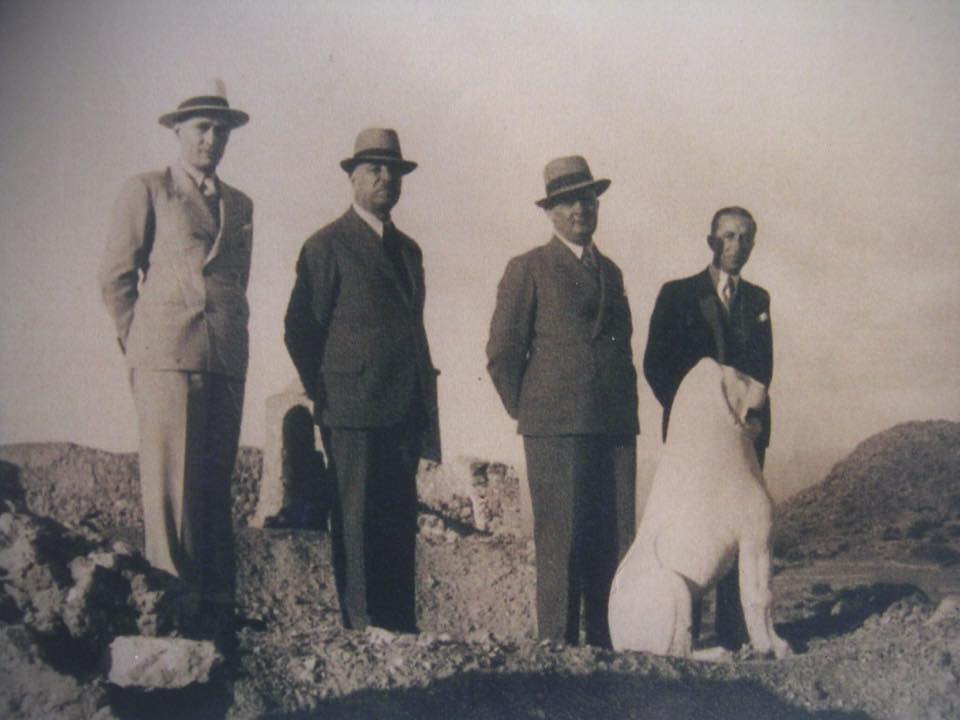
A strange adventure awaited the marble lion that adorned the fortress of Kythira, which was not a Venetian but an ancient Greek creation, most likely from the ancient city of Scandeia. On June 6, 1941, German commander Bruns—likely on the advice of a relative who was an archaeologist—had the marble lion removed and sent it to Germany. As historian Hagen Fleischer told us, amid the chaos of Nazi Germany’s collapse, the lion was found abandoned in a town in the eastern part of the country. After the war ended, locals claimed it came from an Aegean island, though they did not know which one. Photographs of the uprooted lion reached Pergamon, where a German professor recognized the stolen guardian of Kythira.
The request for repatriation seemed ready to be formulated, except that there was one… detail. The post-civil war Greek state had no diplomatic relations with the German Democratic Republic, on whose territory the lion was located. The East Germans, however, in a gesture of goodwill, returned it.
A female statue of a deity, likely from the Hellenistic period, unearthed in Macedonia in 1944, was not so fortunate, even though everything had started under the best of circumstances. The statue was found by chance during the excavation of trenches, and the German administration—in an effort to appease the Greeks—decided to hand it over to the Greek archaeological service. In fact, the handover took place with fanfare and statements about «respect» for the Greeks and their history. The incident took on a propagandistic dimension and was triumphantly published on the front page of the Nazi party organ *Laikos Paratiritis*.
But that’s when the problems began, Mr. Fleischer tells us. When Hitler saw the news, he flew into a rage. “The British would never do something so stupid,” he said, and demanded that the statue be seized immediately. The German archaeologists, who were in Greece and had already been criticized for the handover, tried to downplay the statue’s significance, claiming it dated from the Hellenistic period, when the decline had already begun, but the Führer was unpersuadable. As a result, the statue was stolen and transported to a mine in Austria to be protected from bombing, along with other important Nazi artifacts.