Chile is a country that was once among the most stable economies in the world, yet it currently has one of the world’s widest income gaps—with 1% of the population holding 26.5% of the nation’s wealth. It is also the country that, from 1973 to 1990, was under the military dictatorship of Augusto Pinochet and, from 2010 to 2014, and again since 2018, has been led by President Sebastián Piñera. A politician who remained in office after it was revealed that something he had done constituted a conflict of interest.
In 2010, the mining company Minera Dominga, which was owned by the children of the head of state, was sold to Carlos Alberto Delano, a personal friend of the president. The $152 million transaction took place in the British Virgin Islands (see: tax haven) and was revealed through the Pandora Papers. Nevertheless, the Chilean Senate decided not to indict Piñera and to allow him to remain in office until the elections.
The first round of the election took place on November 21, with José Antonio Kast of the far right and Gabriel Boric of the left advancing to the runoff. The ultra-conservative Kast—a father of nine, an admirer of the country’s former military dictatorship, and known as the “Trump of Chile”—had won by a margin of 2%. As of Sunday, December 19, Boric is the new president.
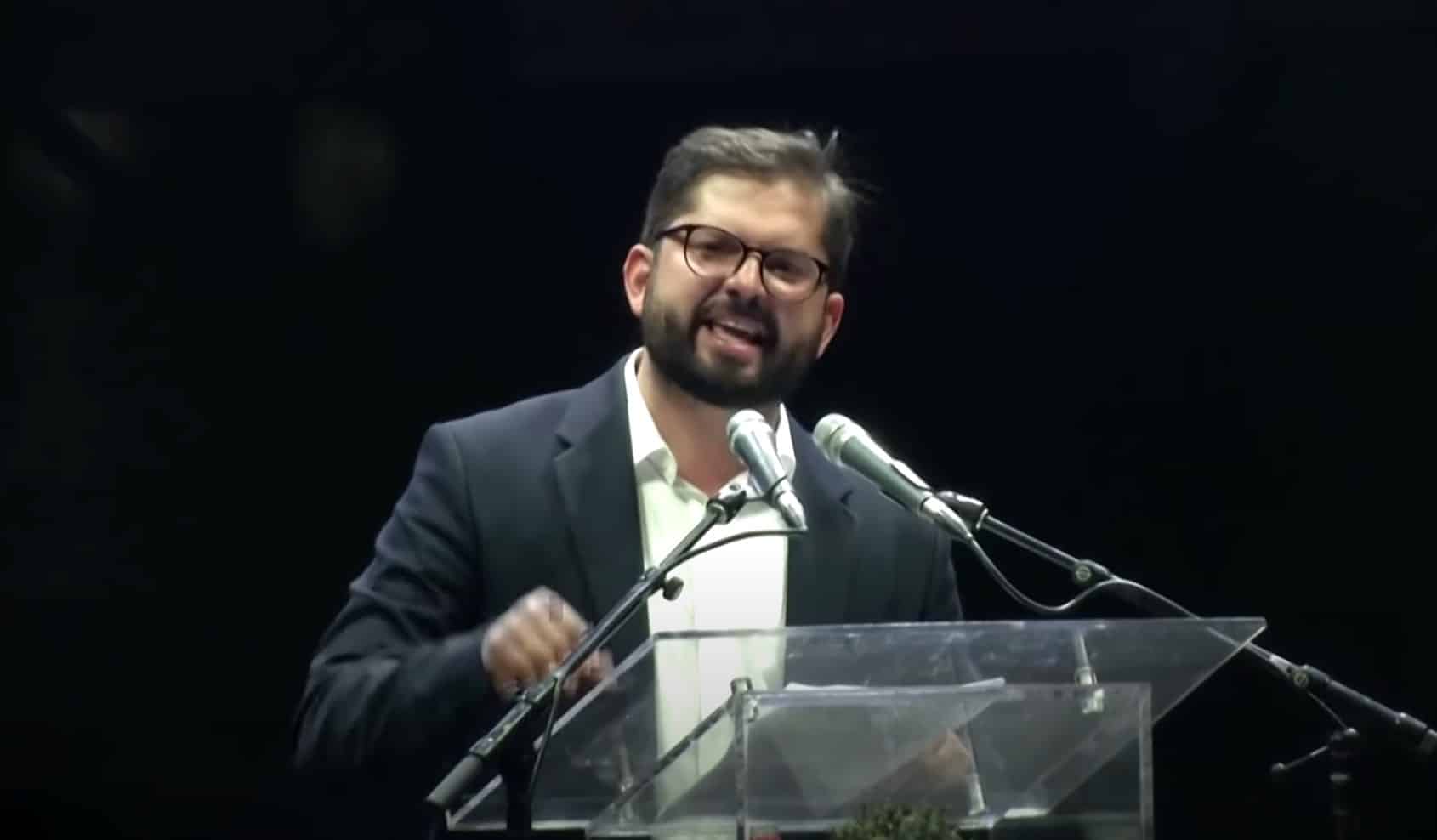
But who is Gabriel Boric Font, who, incidentally, also became the youngest president in his country’s history, receiving more votes than any other presidential candidate (56%) in Chilean history? He is the man who is expected to “bury the legacy of dictator Augusto Pinochet once and for all,” as The Guardian writes. It should be noted that he has what it takes to achieve this, but nothing can be taken for granted until it actually happens.
Protesters with their hands up were shot by police with pellet guns in Chile. More here: https://t.co/qIPoM1MCvp pic.twitter.com/S8WC1JD4rl
— Reuters (@Reuters) October 25, 2019
Previously, he had led the social uprising of October 2019 (against economic inequalities; among the demands was a new Constitution, as the existing one was a relic of the military dictatorship). It was the most serious uprising of the past 30 years.
Twenty-four (24) people lost their lives, including a four-year-old. At least five were killed after coming under fire from security forces. There were 584 injured, 245 of whom had been shot, while the number of those arrested exceeded 6,000. The UN had announced that it would send experts, with the government assuring that the military (20,000 members of the armed forces had been deployed) was acting to protect the rights of Chileans.
#repost @lifeintheendtimes
・・・
CHILE UPDATE📰 An apology and promises of economic reform from President Sebastián Piñera failed to quell the unrest and rioting in Santiago, CHILE. Protesters shouted, “Chile has woken up!” The protests reportedly led to 18 deaths. Oct. 23, 2019. pic.twitter.com/FspsuuUdWw— Create Something 🧠 (@Discipl79813716) October 24, 2019
The people of Chile, disillusioned with traditional political parties, handed the reins to the left, in the hope that it would be able to save the day. In other words, they did what their neighbors (Chile, Bolivia, and Peru) have done, and what has happened in other parts of the world as well.
Borich, who will be 36 years old when he takes office on March 11, 2022, has pledged to tackle inequality by reforming the pension and healthcare systems, reduce the weekly workweek from 45 to 40 hours, and boost green investments—he made it clear that he will not favor metal mining operations such as those of Minera Dominga. She has committed to decentralizing Chile, implementing a welfare state, increasing public spending, and including women and indigenous communities.
«The story begins with us»
What you just read above is the first thing Boric said after his victory. Born on February 11, 1986, in Punta Arenas (the capital of the country’s southernmost region), he is the son of Luis Borić, who is of Croatian descent, and Maria Font, who is of Catalan descent.
Mr. Borić—a chemical engineer—served for four decades as president of Empresa Nacional del Petróleo, a state-owned company responsible for the exploration, production, refining, and marketing of hydrocarbons in Chile (in charge of oil exploration and production in the Land of Fire). Gabriel attended an English school in his hometown and moved to Santiago to pursue his studies (in law).
He became politically active in middle school, when he began reading Marx and Hegel—with his father’s permission. He was also an outstanding student. In 1999, he participated in the reestablishment of the student federation in his city, focusing on secondary education, and upon entering the Universidad de Chile, he joined the Autonomous Left—which was then known as the Autonomous Students. In 2008, he became an advisor to the Law School Student Union, and a year later he was elected president.
In that capacity, he led a protest/occupation against the dean that lasted 44 days. Borich, then 23, was the one who proposed that the well-known criminal’s candidacy for school leader not be celebrated—a proposal that was approved. His fellow students said he had always been on the lookout for what was about to happen at the school, even before it happened. As La Tercera reports, his motto was ‘excellence and dedication,’ and from the very beginning he had made it clear that “I don’t believe in witnesses.” His professors had noted that “he had a calm personality and kept a low profile,” which he set aside when he was fighting for a cause.
In 2011, during his final year of studies, he ran for president of the Student Federation at the Universidad de Chile and received 30,52% of the votes, a percentage that secured him the presidency. He defeated Camila Vallejo, who was seeking reelection as a representative of the Communist Youth. As president of the Chilean Student Federation (FECH), he became the face of the 2011 student protests that paralyzed the state and were led by young leaders —all members of Boric’s presidential campaign—who went on to become politicians.
Incidentally, Vallejo was the press spokesperson—and *The New York Times* magazine described her as “the world’s most dazzling revolutionary,” helping to establish her as Chile’s most influential communist figure of the 21st century. Borich was named by El Mercurio as one of the country’s 100 young leaders.
Borich never earned a college degree. He won the 2013 congressional election (as an independent, he received more votes than any other candidate in the district —15,418) and became one of the first representatives not to come from the two traditional coalitions—breaking the two-party system. He served two terms as a member of parliament, during which he focused on human rights, indigenous cultures, labor, and social security. Upon his re-election, he also increased his share of the vote.
On July 18, 2021, she won the primary election for Apruebo Dignidad (Chile’s left-wing party, which was officially founded in January of that year), receiving 60% of the vote. His opponent was the mayor of Recoleta, Daniel Jadue, whom the polls had predicted would win. Following his victory, Boric announced that he would collaborate with Jadue to present a united front. For the record, Vallejo had supported Jadue.