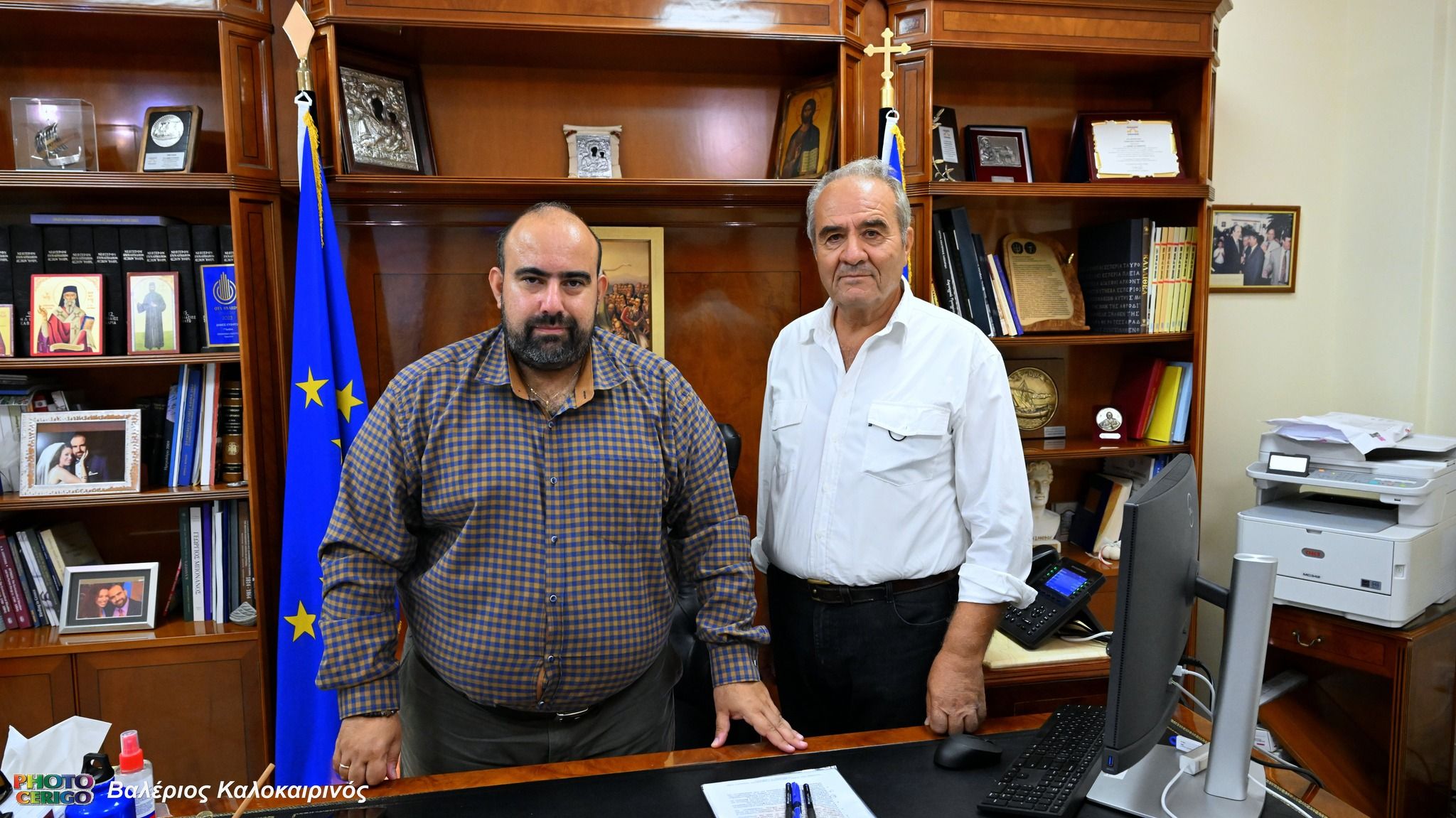
With one a detailed joint statement, the Mayor of Kythira Efstratios Charhalakis and Evangelos Venardos, Chairman of the Domestic Property Commission (EEPKA) are attempting to provide a an end to public disputes regarding the administration and management of Holy Pilgrimage Sites of the island. This statement marks a significant decline on the attacks the day before yesterday from the Mayor for further Legal action against Metropolitan Seraphim of Kythira, as it is reported that the issue is now considered «have expired, both legally and in substance». A typical example is the 180-degree turn the Mayor’s stance regarding the announcement of legal actions in recent days, since, as stated in the joint statement, «The Municipality and the Local Property Office are already planning a major event in honor of the Metropolitan, with prominent figures invited...».
Key points of the joint statement
- Termination of Legal Proceedings: The Mayor and the President of the Local Property Authority emphasize that this is their final position on the matter and that they will not take any further legal action against the Metropolitan, despite initial reports of legal appeals. It appears that the intervention of representatives from the Kythira associations had a decisive influence on the Mayor’s stance, as he had recently been proclaiming that he would seek €35,000 from the Metropolis and the Synod on behalf of the Municipality and the Local Community (to cover legal fees, though it is not yet clear whether this demand has been withdrawn from the «table» of negotiations).
- Excerpt from the Council of State’s Decision: The joint statement refers to the decisions of the Council of State (1475/2024 and 1476/2024), which, according to its authors, confirm that the administration and management of the Holy Pilgrimage Sites fall under the jurisdiction of the Domestic Property Department, and completely rejecting the Church’s allegations.
- Criticism of the Metropolitan's Statements: The Mayor and the President of the Local Property Authority have characterized the Metropolitan’s statements regarding «invisible hands» and «interference» as unsubstantiated and offensive to the judiciary, calling on him to retract his statements (without any further announcement of legal action…).
- A Call for Unity: The statement concludes with a call for unity and cooperation, emphasizing the importance of the distinct roles of the municipality, the State Property Agency, and the Church, as defined by legislation and judicial precedent.
The mayor’s decision not to pursue further legal action is seen as an effort to defuse tensions and restore balance to the relationship between the municipality and the Church. Despite the intense confrontation of recent months, the message the joint statement seeks to convey is the need to respect court rulings and preserve the unity of the people of Kythira.
The mayor’s stance has already sparked debate in various circles, with some characterizing it as a conciliatory move and others interpreting it as a sign of responsibility. At the same time, the question remains whether this statement will truly mark the end of the disputes or whether tensions between the two institutions will flare up again in the future. Nothing can be certain until we see the reactions from the other side.
Please read the joint statement below:
JOINT STATEMENT BY THE MAYOR OF KYTHIRA AND THE CHAIRMAN OF THE LOCAL PROPERTY COMMITTEE
Kytherians and Kytherians,
Following the official publication of the Council of State’s decisions Nos. 1475/2024 and 1476/2024 (Section C), presided over by the Vice President of the Supreme Court of Cassation, Mr. Diomedes Kyriopoulou, we are obliged to provide a comprehensive and detailed response to the statements made by His Eminence Metropolitan Seraphim of Kythira and Antikythira, in his public announcement dated October 16, 2024, regarding the Holy Pilgrimage Sites on the island of Kythira, as well as in the Resolution of the Priests of the Metropolis of Kythira dated November 172024 Resolution of the Priests of the Metropolis of Kythira. We wish to clarify from the outset that the purpose of this response is to provide information and to dispel, with supporting evidence, any misinterpretations or unfounded opinions that are being circulated, and therefore it is the last one and we will never bring up the subject again, as it is now considered have expired definitively and irrevocably.
- First, let us clarify that the jurisdiction to rule on the specific petitions for annulment filed by the Church of Greece and the Holy Metropolis of Kythira in 2017 lies with exclusively by the 7-member panel of the Third Section of the Council of State and NOT by the Plenary Session, as the Metropolitan groundlessly and erroneously claims. This is because, according to Article 14, paragraph 2, of Presidential Decree 18/1989, The Plenary Session has jurisdiction only for: a) a matter or case referred to it by a Division’s decision due to its greater importance, particularly when it concerns issues of broader significance, (b) a matter or case that is mandatorily referred to it by a decision of a Division when it has already ruled that a statutory law is unconstitutional (it should be noted that the Local Government Act was ruled constitutional once in 1986, and this constitutes a final and irrevocable ruling that is binding on all subsequent rulings) and (c) any case referred to it the President of the Council of State when it determines that she has «of the utmost importance». In short, the Metropolitan is mistaken—both legally and substantively—regarding the Plenary Assembly’s jurisdiction over this specific matter. And one cannot help but wonder how he can be so certain, and where his certainty comes from, that the adjudication of these appeals by the Plenary would have yielded a different outcome than that reached by the seven-member panel of the, which is the only competent body?;
- Certainly, one’s right to seek redress through the courts cannot be denied, even when such a recourse is manifestly unfounded. In this sense, the Church had the right to file petitions for annulment with the Council of State in 2017, in connection with the update of Presidential Decree 272/85, However, it was aware that the provisions of the challenged Presidential Decree were intended solely to adapt Presidential Decree 272/85 to the new structure of local government, without altering the existing institutional framework, and therefore knew in advance that he was acting in vain. For this reason, the Church’s filing of these motions for annulment is rightly characterized as provocative and unprovoked, a fact that was, after all, amply demonstrated by the decisions of the Council of State and their underlying reasoning. Dozens of people told the Metropolitan this at the time, but he persisted.
- The Charter of the Church of Greece, to which the Metropolitan frequently refers, WAS SUBSTANTIALLY AMENDED by the Law on Church Property, specifically and exclusively with regard to the Holy Shrines of Kythira. This was accepted with absolute clarity and categorically by the decisions of the Council of State, which state, in particular: «Because Law No. 1416/1984, which essentially amends Article 59 of the Statute of the Church of Greece (Law No. 590/1977) […] stipulated that, specifically, the administration of the domestic property of the islands of Kythira and Antikythira, which includes the property of the holy shrines of Panagia Myrtidiotissa, Agia Moni, and Agios Ioannis en Kremno, as well as the chapels belonging to them, falls under the jurisdiction of the Committee on Local Property […]» (paragraph 8). Therefore The KX does NOT apply and is NOT enforced in the case of the administration and management of the Sacred Pilgrimage Sites of Kythira because the Council of State ruled (both in 1986 and in 2024) that the State has the inalienable right, as a regulatory authority, to regulate matters of management and administration of ecclesiastical institutions, monasteries, etc., at its sole discretion. We remind the Metropolitan that the administration and management of such matters, which are purely administrative in nature—and which affect neither Doctrine nor Divine Worship — is not carried out in accordance with the Holy Canons, but with the laws of the state. This naturally raises the question: if tomorrow the government decides to bring all the churches and metropolises of Greece under the Public Accounting System and the Transparency Initiative, will the Metropolitan of Kythira object on the grounds that this is «prohibited by the Fourth Ecumenical Council of 451 AD»?;
- The Ownership Status of Churches and Monasteries in the Ionian Islands It is unique and clearly distinct from the rest of Greece. As the Supreme Court has held (Decision 475/2016, Third Civil Division), specifically in the case of the Ionian Islands, pursuant to Article 74 of Law 2200/1940 «On Churches and Priests,» churches were classified as: a) parish churches, b) confraternity churches, c) founder-owned churches, d) community churches, and e) privately owned churches. By a legislative decree of the General Superintendent of the Navy dated August 26, 1754, all decrees, laws, regulations, and applicable practices of the Ionian Islands regarding the classification of churches and monasteries were codified. Under this decree, the churches of the Ionian Islands were divided into two categories: the “collegial” churches—that is, those built and maintained through equal contributions by the clergy—and the patronal—under patronage. The latter (patronage churches and monasteries) were divided into churches governed by private law (jus patronato privato) and those under public law or under public patronage (jus patronage publico). The financial management of these churches was overseen by the administration of each island in the Ionian Islands, and under no circumstances by the local Metropolis. The regulations and institutions governing the churches of the Ionian Islands, as well as their codification by the General Superintendent of the Navy, were maintained during the period of foreign suzerainty over the Ionian Islands—following the Venetians—and until their union with Greece in 1864. However, and following the Union, the validity of these regulations remained in force pursuant to Law RN/1866, while a special provision regarding the churches of the Ionian Islands was also included in Law AN 2200/1940. The Sacred Pilgrimage Sites of Kythira have never belonged to anyone—nor is it even speculated that they ever did (a phrase quoted verbatim from Council of State Decision No. 1956/1986) – in the administration of the Church, as the Council of State has also acknowledged (1956/1986). On the contrary, it is established by irrefutable historical, customary, and legal evidence that they have always constituted churches and monasteries under the patronage of public law (jus patronage publico).
- The nature of the Holy Pilgrimage Sites is NOT related to who owns them or which entity is responsible for their financial management and administration. Whether they were monasteries or not, Ownership of these properties NEVER belonged to the Church but ALWAYS belonged to the people of Kythira as jus patronage publico. Even when—through «laws» enacted by the occupying «governments»— — the incumbent Metropolitan of Kythira was appointed President of the Local Property Administration, he administered the Holy Shrines NOT in his capacity as a bishop, NOR as if they belonged to the Church, but exclusively in his capacity as President of the Local Property Authority and nothing else. The Metropolitan largely ignores significant and indisputable evidence supporting the above and cites only a few references, in an extremely superficial manner, which cannot overturn a historically proven status quo spanning nearly four centuries. And since His Eminence wishes to «Let's be precise and avoid vague language», let us mention a few examples—purely by way of illustration—of the popular character of the sacred pilgrimage sites of Kythira that have been published:
- In the *Inventario Ecclesiastico* of 1675, which the distinguished Byzantinist Chrysa Maltezou mentions in her book and which is preserved in the Kythira archives (in contrast to other evidence of the popular nature of the pilgrimages, which was stolen years ago by ravenous wolves), is recorded by decision of the Mayor of Souda—that is, of political authority rather than ecclesiastical authority – the movable and immovable property of all the monasteries and churches on Kythira that belong to the State, including Myrtidiotissa. This is the earliest recorded evidence of the popular and public nature of the pilgrimage sites on Kythira.
- On September 28, 1776, a protocol for the handover and acceptance of the Pilgrimage Site of Myrtidia was signed. During Venetian rule, Myrtidia was granted in perpetuity. by a ducal (rather than ecclesiastical) decree to a representative of the authorities.
- On December 28, 1799, following a local revolution that was ratified by notarial deed issued by the Public Notary of Mylopotamos, the people are taking control of Myrtidiotissa away from the nobility. At the same time, they are doing the same with the Church of St. Nicholas in Avlemonas, an issue that will be addressed shortly.
- The 1825 Inventario states that the Pilgrimage of the Myrtidians was «authentic,» meaning it belonged to the government.
- The 1827 Statutes of Myrtidiotissa state that The monastery is public; financial administration was the responsibility of the District Governor of Kythira and the British Resident, who jointly selected the Abbot, and his election was ratified by the Ionian Senate in Corfu (The Church was completely absent, even from the election of the abbot!).
- In the «Minutes» of the District Governor of Kythira, Ioannis Kaloutsis, and the District Council, dated October 12, 1842, which is ratified by the British Vicar General (and not by the local bishop), the custom of the «Gira» was officially established, and it continues to this day.
- On May 26, 1845, Issue 24 of the Official Gazette of the United State of the Ionian Islands published the First Act of the Senate (the Ionian Parliament), which regulates matters concerning the Local Fund of the islands and explicitly stipulates that Monasteries and shrines are part of the local revenues.
- The Code of Bishop Eugenios Macheriotis of Kythira recognizes the authority of «the Noble Local Council of this island» over the Holy Icon and the Monastery of Myrtidia.
- The Opinion of the State Legal Council dated July 27, 1892, acknowledges that Myrtidiotissa's assets belong to the Local Estate, a point that has been reiterated in numerous opinions and decisions of the National Council of State (e.g., Opinion No. 359/59 of the National Council of State), as well as by the relevant ministries to this day.
- Through a series of notarial deeds (e.g., 1895, 1900, 1902, 1903, etc.), auctions were held for the lease of the Myrtidia estates, the construction of cells in Myrtidia, etc., by the Local Property Administration, chaired by Kythira Public Treasurer.
- From the statements of the late Metropolitans of Kythira, Meletios (1968), Sotirios (1972), and Ierotheos (1979), it is evident that they fully accepted the placement of the Pilgrimage Sites under the administration and management of the Domestic Property Department.
- The mere invocation of the two «laws» enacted by the collaborationist «governments» of Tsolakoglou and Rallis during the Occupation is provocative and offensive to every democratic citizen! Because these «Laws» abolished the centuries-old popular administration of local property (Justice of the Peace, Public Treasurer) and—in a thoroughly fascist move—appointed the current Metropolitan of Kythira as President of the Local Community. In 1941 and 1943 —whether the Church likes it or not, whether it realizes it or not, whether it accepts it or not—the Pilgrimage Sites ALREADY belonged to the Church’s Domestic Property (as early as 1675, if not earlier!). These occupation laws simply replaced the previously elected President of the Local Community with the respective Metropolitan, However, they did not alter in any way the provisions that had been in force until then, according to which the Sacred Pilgrimage Sites of Kythira had belonged for centuries to the Local Estate. Under these laws, the respective Metropolitan of Kythira administered the pilgrimage sites not as a church official but as the chairman of the Local Property Administration., plain and simple! This fascist regime of collaborationists during the Occupation Law 1416/84 remedied this, restoring democratic normality to the institution with regard to popular administration. However, we have an answer even for those who invoke—without any qualms—these fascist laws: on February 4, 1938, the coup leader Ioannis Metaxas sent a letter to the Domestic Property Fund bearing his original signature, thanking the Committee’s President for the donation of 10,000 drachmas from the Myrtidiotissa fund «in support of the Royal Air Force»! Even he respected and accepted the people's administration of the Pilgrimages!
- We are in complete agreement with the Metropolitan regarding his reference to local tradition. However, 20 years after his enthronement in Kythira, he should have realized that the island’s strongest local tradition—which the Holy Spirit and the Holy Synod entrusted him to shepherd in 2005— is the Local Property and everything it encompasses. And since, in his affirmation before the President of the Republic, he assured «in his honor and as Archbishop» that he will respect the laws of the State, he MUST also respect the specific laws governing rural property, which are also laws of the State and have been definitively and irrevocably ruled to be constitutional. Respecting the law on an “à la carte” basis cannot be a choice made by sensible people.
- ALL of the Church’s arguments and claims were essentially rejected by the two decisions of the Council of State, which ruled that: a) Presidential Decree 5/2017 did NOT introduce any new regulations whatsoever; it merely adapted the institution’s operations to the Kallikratis Plan (something that should have been done as early as 2010), b) The two Regulations that the Metropolis issued «in secret» through the Synod (and, moreover, after the contested Presidential Decree had been issued—an issue addressed in the Council of State’s decisions, paragraph 9) are characterized by the Council of State as «null and void» and as having no legal basis (!), meaning they are annulled, (c) the entire legal framework of the Local Authority (which the two appeals sought to overturn) is not flawed either legally or constitutionally as the Metropolitan has stated dozens of times, (d) The Statute of the Church of Greece does NOT apply to the administration and management of the Holy Pilgrimage Sites of Kythira, as amended in accordance with the law and the Constitution by Law No. 1416/84 and Presidential Decree No. 272/85, e) Ownership of the Holy Pilgrimage Sites belongs to the Municipality (intercommunal and now municipal) and (f) Their management and administration fall under the jurisdiction of the Local Property Committee, matters of worship, however, fall under the exclusive jurisdiction of the Ecclesiastical Council, of which the Metropolitan is and remains the President.
- As a result of all of the above, Our Lady of Myrtidiotissa and St. Moni are NOT monasteries but holy shrines, and as such should be referred to as such by everyone, including the Holy Metropolis and the local bishop. Only the Monastery of Saint Theodore is a canonical monastery on Kythira.
- We reiterate that the revenues of the Holy Pilgrimage Sites are the only church funds nationwide that are part of the public accounting system, all expenditures of the Holy Pilgrimage Sites are carried out and audited in accordance with the law on public expenditures (e.g., Law 4412/2016, etc.) and are published on the “Diaugia” transparency portal and the Public Contracts Registry, with full transparency. And of course, in accordance with Presidential Decree 272/85 (Art. 18), the revenues of the Holy Pilgrimage Sites are used exclusively to cover their own expenses and not those of other entities.
- The Council of State's rulings held that the laws governing local property «reflect the historical reality that dates back to the 1817 Constitution of the Ionian State», in Article 1 of Act X/May 14–26, 1845, of the Eighth Senate, in Articles 10 and 11 of Law RN/1866, etc., culminating in Article 84 of Law 1416/1984 (consideration 11 of Decision Council of State/Section C/1476/2024). Consequently, The provisions of the 1817 Constitution of the Ionian Islands were incorporated into national law following the Union of the Ionian Islands, and this was done in a manner that was entirely lawful and constitutionally compatible..
- The so-called «lack of respect, arrogant attitude» etc. are not even worth commenting on. So what exactly did the Metropolitan want? To have us reward him for the fact that the Municipality and the Local Community were saddled with tens of thousands of euros in legal fees due to his baseless motions to set aside the decision?; Is it not a lack of respect to divide and cause scandal among the flock—especially over an issue that has been definitively resolved since 1986?; ? This made a deep impression on the congregation—not our effort to protect the traditions left to us by our ancestors, which we are duty-bound to pass on intact to future generations!
- The Metropolitan's public statements on «interference by politicians and other individuals», «invisible hand» etc., as well as the incomprehensible attempt to link these decisions to Minister N. Dendias’s visit to our island (!) lack even a modicum of seriousness and offend public sensibilities. If His Eminence has even the slightest suspicion, indication, or proof regarding these unprecedented accusations—which gravely insult the judiciary and its officials by implying they are allegedly prone to «interference,» let him make them public NOW or else retract them! The Council of State judges’ deliberations on these rulings took place on April 16, 2024; Mr. Dendias visited our island 5.5 months later! Let him look elsewhere for the «interventions» he’s seeking—and certainly not at the Municipality or the Local Property Office.
- The mayor’s positions and views on this issue were clear and unambiguous long before he was elected mayor, and they are documented in many of his public statements, in contrast to the views of other (elected officials) who have avoided—and continue to avoid to this day—taking a clear stance on the issue and continue to observe these truly historic moments for our island from the sidelines. As early as 2006, when the current mayor first became involved with the Local Property Office alongside then-Chairman Kostas Mariatos, he always expressed the view that the system for managing and administering the Pilgrimage Sites neither should nor can change. However, when he himself assumed the chairmanship of the Committee, he was subjected to various forms of advice and pressure from ecclesiastical circles and figures outside Kythira («You, who go to church and sing—you have to do something.»…), who naively believed that a Village Council President sympathetic to the Church—such as the current mayor—would simply hand over (?) the pilgrimage sites to the Metropolis of Kythira! So the only appropriate response to all this pressure was the one that was actually given: «Go to the Minister of the Interior and have him give them to you»! Nothing more, nothing less!
- The protection of domestic property and any movable or immovable property falling under its jurisdiction is the exclusive responsibility and obligation of the Commission. The Holy Icon of Myrtidiotissa is ALSO included in the Domestic Property, as well as every asset of the Holy Pilgrimage Sites, from the estates and olive groves to the sacred vessels. Which set of chalices the priest of Myrtidia will use for the Divine Liturgy is entirely his own decision, but whether, for example, a Gospel book should be restored or gilded is a matter for the parish, because it involves an expense and falls under the jurisdiction of property protection. It is the LOCAL COMMUNITY’S OBLIGATION to immediately restore the Icon of the Virgin Mary, which has never been restored to date, posing a visible risk of serious damage or the loss of any unique historical details that may exist beneath the gold leaf (e.g., an inscription, information about the iconographer, etc.). The preservation of the Icon is part of the obligation to protect all elements of the National Heritage, and as such does not require the approval or consent of the Metropolitan, since, among other things, the icon is automatically protected under the Archaeological Law. Moreover, most miraculous icons have undergone similar restoration work throughout Greece. However, We never claimed that the maintenance would take place without the Metropolitan’s knowledge! Once the standard bureaucratic procedures that are the responsibility of the local municipality (studies, approvals, etc.) have been completed, A special room will be set up at the Shrine as a conservation area, equipped with cameras and high-security measures; the Icon will NOT be taken off the island for conservation, but the conservation work will be carried out on site, and the Metropolitan or the Shrine’s priest may be present throughout the entire process and, of course, be informed of any historical findings that the conservation work may reveal. An example of disrespect is the insistence on not preserving the icon, not the opposite. Moreover, as mentioned above, the Code of Bishop Eugenios Macheriotis of Kythira (1857–1876) recognizes the authority «of the Noble Local Council of this island» on the Holy Icon and the Monastery of Myrtidia, so there is no need for any further discussion on the matter.
- Finally, we wish to state that this is our FINAL position on this matter. The matter is considered closed, both legally and in substance. The issues regarding the administration and management of the Holy Pilgrimage Sites have been resolved definitively and irrevocably by the Council of State, and this CANNOT be changed; therefore, the circulating «threats» regarding European courts or attempts to amend the founding law of the Local Community (!), are not only divisive and hostile toward Kythira and its residents, They are also completely meaningless, since a) The ECHR (European Court of Human Rights) has NO jurisdiction to overturn or alter national court decisions, it does NOT act as an appellate court, and it will NOT award any compensation since all court rulings (Supreme Court, Council of State, etc.) as well as irrefutable historical evidence have conclusively determined that The Church has never had ownership of or managed the sacred pilgrimage sites of Kythira; therefore, it lacks a substantive legal interest. and b) The Law on Domestic Property is unshakable and robust, as it has been upheld by final court rulings from both the Council of State and the Supreme Court, which have held that the Laws on Domestic Property «reflect the historical reality that dates back to the 1817 Constitution of the Ionian State» (Paragraph 11 of Decision No. ΣτΕ/Τμ.Γ΄/1476/2024) and are fully consistent with the Constitution.
Kytherians and Kytherians,
Our position on the issue of holy pilgrimage sites is not clear «out of self-serving motives and expediency» as the Resolution of the Priests of Kythira unacceptably states. It is a reckless and extremely offensive statement (even criminally punishable, but we will not pursue the matter) toward people who, for many years, have clearly demonstrated their integrity in public life and have been rewarded by the electorate in successive elections. The priests of Kythira should reflect on the Church’s repeated legal defeats in this matter and on the long-standing division within the local congregation that these have caused, and they should demand that their Bishop put a definitive end to these tiresome claims and allegations regarding the alleged unconstitutionality of the Law on Local Churches. After all, «Three sins are not those of a wise man»! These practices and tactics are an affront to every Kythirian who honors and respects the oldest institution of their homeland and places their trust in it.
Respect for court rulings is a sign of civility, decorum, and basic seriousness.
At the dawn of 2025, when the Metropolitan of Kythira will have completed 20 years of pastoral service in our Holy Metropolis, the Municipality and the Local Community are already planning a major commemorative event in his honor, inviting prominent figures from the ecclesiastical, cultural, political, and social spheres, highlighting his significant pastoral work over the past two decades, his dedication to Divine Worship even in the most remote chapels, his social and spiritual contributions, his humility and selflessness, and all the qualities that distinguish the Bishop of Kythira.
We demand, however—as does the overwhelming majority of the people of Kythira — that all divisive practices regarding the issue of the Holy Pilgrimage Sites cease, and we declare that, as the Municipality of Kythira and the Local Property Committee, we will continue to support the spiritual and social work of His Eminence, based on the distinct roles each one as they have been established and clearly defined a) by the age-old local historical tradition, b) by the indisputable and all-powerful historical, legal, and religious reality, and c) by the law and indisputable court rulings.
Thank you for your attention.
Kythira, November 20, 2024
THE MAYOR OF KYTHERA
EUSTRATIOS ΧΑΡΧΑLAKIS
THE CHAIRMAN OF THE EEPKA
EVANGELOS VENARDOS