Five internationally renowned visual artists, including Paolo Barbieri, the Monika Baisner, the Domenico Paladino, the Tom Phillips and Emiliano Ponzi they give shape and color to the striking images described by the poet Dantis in his monumental work, *«The Divine Comedy».
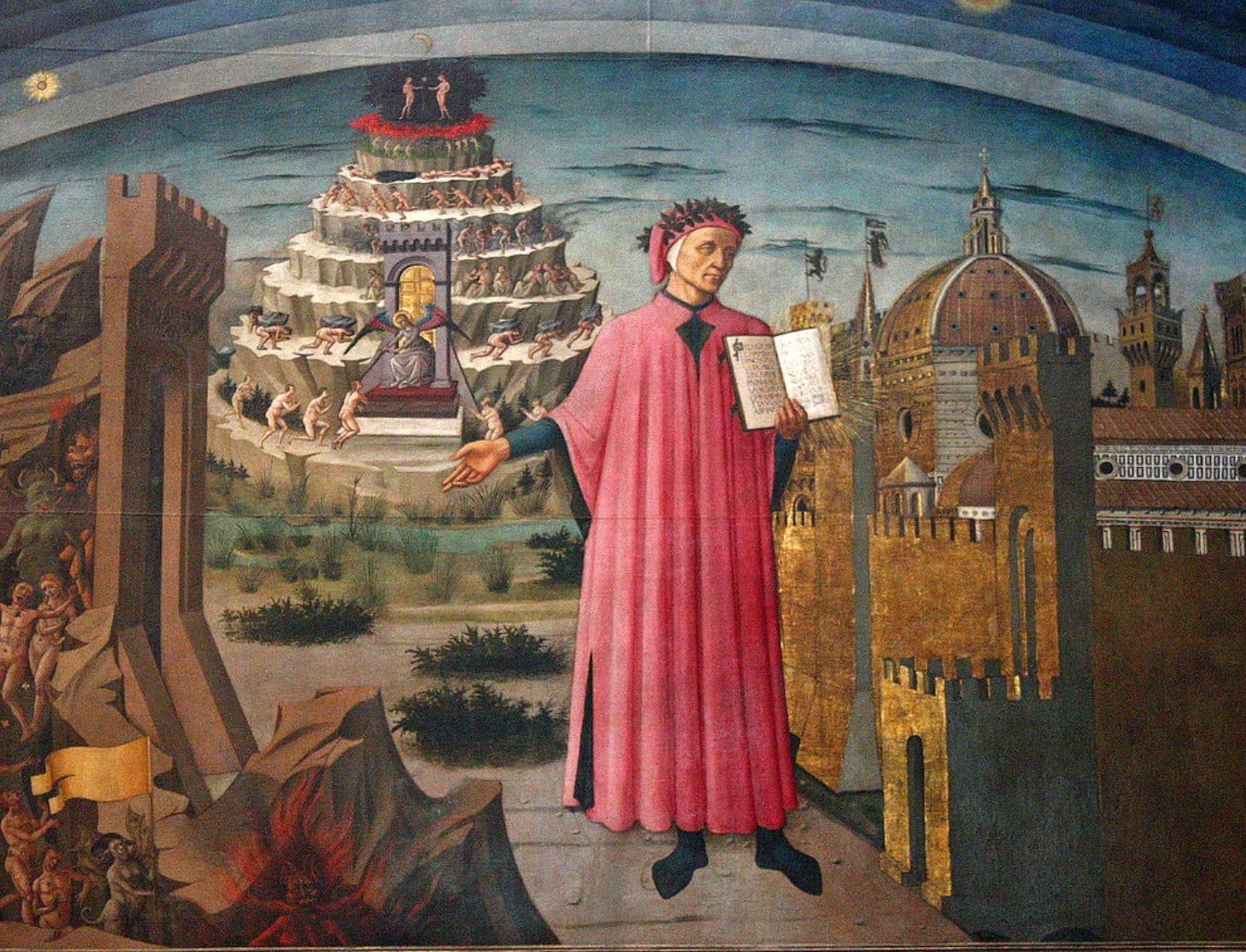
The artists bring Dante’s Inferno, Purgatory, and Paradise, demonstrating that the mark Dante has left on European culture remains indelible—a constant source of inspiration for contemporary artists.
The Italian Cultural Institute of Athens presents the exhibition «Dante the Hypermodern (Dante Ipermoderno) – Dante Illustrated in the World, 1983–2021».
This is a major traveling exhibition—before coming to Athens, it was shown in Belgrade, and next, the illustrated Dante will visit Prague, Moscow, and London before ending its run in Madrid—on the occasion of the the 700th anniversary of the death of the most important poet in Italian literature, Dante Alighieri (1265–1321).
The curator of the exhibition is a professor of modern art history at the University of Florence Giorgio Bacci (Giorgio Bacci, Associate Professor of Contemporary Art History, University of Florence).
In the foreword to the exhibition catalog, Patricia Falcinelli, the Italian Ambassador to Greece states: «This year, marking seven centuries since Dante’s death, we celebrate the iconic figure and extraordinary legacy of the Greatest Italian Poet, who, through his Divine Comedy, succeeded—as few others have—in shaping and enriching the foundations and evolution of Western civilization. Dante’s influence remains as relevant as ever, transcending the boundaries of time. Transcending geographical borders and the confines of thought, Dante has endured to the present day as a leading figure, continuing to inspire reflection, guide artists on their creative journeys, spark discussions, and stimulate critical thinking.».
Timelessly modern for seven centuries
Dante (1265–1321), seven hundred years after his death, remains entirely relevant; he is «ultra-modern,» since his poetic discourse not only delves into the depths of the human soul but also radiates out toward society, chronicling the conflicts and dynamics that unfold within it.
He is considered the father of the Italian language, as his *Divine Comedy*, the work that became widely known when *Boccaccio* described it as «divine,» , is regarded as one of the masterpieces of world literature. In it, the philosopher and scientist-poet—who bridges the Middle Ages and the Renaissance—crystallizes not only the religious trends of his era concerning Paradise, Purgatory, and Hell, but also the mores that prevailed at the time in both the public and private spheres: it was not only sinners, adulterers, murderers, or the gluttonous who were punished for all eternity, but also the corrupt officials of his time, the political swindlers.
After all, Dante became involved in politics at a young age, supporting the White Guelphs in Florence against their rivals, the Ghibellines, as well as against Pope Boniface VIII, a stance that cost the poet many years in exile—Dante Alighieri did not die in his beloved hometown of Florence, but in Ravenna, where he spent the last years of his life.
The brightest minds of humanity have studied his work, fascinated by the description of the poet’s descent into Hades, guided by his mentor, the poet Virgil, and his ideal and eternal beloved, Beatrice. It should be noted that Beatrice was a real person: Dante met her when they were both young children and loved her for the rest of his life. She was indeed the poet’s first platonic, intense love, until Beatrice Portinari died at a young age without them ever being united. Later, Dante married Gemma, the daughter of a powerful and wealthy family, with whom he is believed to have had three children. However, the poet makes no mention of her anywhere.
One of the most important Greek writers to have studied Dante’s work is Nikos Kazantzakis, who translated *The Divine Comedy* in a distinctive, poetic style, dedicating it to the memory of Angelos Sikelianos.
The artists featured in the exhibition
The five artists participating in the exhibition represent the latest chapter in the long history of illustrating Dante’s work. Painters of the caliber of Gustave Doré, Dalí, Guttuso, and Rauschenberg have «confronted» Dante’s gloomy universe, presenting the public with masterpieces that captivate the imagination. Now, five contemporary artists are taking up the baton, each narrating Dante’s epics in their own way through the aesthetic language of the present. From the more traditional visual style employed by Palantino, Baisner, and Phillips, to Ponzi’s digital technique and Barbieri’s ethereal, fantastical landscapes, the five artists shape an experiential dialogue between the great Florentine poet and his audience.
Starting with the one and only lady of the group, let's say that the German woman Monika Baisner (79 years old), is the only female painter to have illustrated the Divine Comedy in its entirety. Her works, painted in egg tempera with a unique attention to detail, are characterized by power and passion. For example, the Lord of Darkness, in the depths of Dante’s Inferno, is a direct reference to Goya’s *Saturn Devouring His Children*. Beissner has had a long and distinguished career as an illustrator in the world of picture books for young children, yet her distinctive style is clearly evident in her engagement with the classics of world literature. This prominent and unconventional German illustrator devoted seven years of hard work to this ambitious project based on Dante’s Divine Comedy.
Despite his young age (43), Emiliano Ponzi is one of the best-known and most internationally recognized illustrators – His work has been published in The New York Times, The Washington Post, *Le Monde*, *La Repubblica*, *Der Spiegel*, and other publications of comparable stature. He has collaborated with the Museum of Modern Art in New York, and his aesthetic and professional ties to the United States and its culture are strong. His exclusively digital work is characterized by an allusive clarity — Ponci says what he wants to say in a clear and concise manner, using a stylized, colorful roughness that makes his images immediate and explosive.
British artist Tom Phillips (84) is exhibiting nine silkscreen prints derived from the 139 images of Dante’s illustrations that tell the story of his *Beyond Dante* in an expressive, pop style.
He is a multifaceted artist who has experimented in various fields: theater, music, and film. He has exhibited visual artworks in Europe’s most prominent galleries, and his approach to Dante’s work has transcended artistic conventions: his use of multimedia, in collaboration with Peter Greenaway, offers new interpretive possibilities for engaging with *The Divine Comedy*.
The 73-year-old Italian Domenico (Mimo) Paladino is a globally recognized painter, sculptor, and ceramicist who has also created major visual art installations in theaters and outdoor spaces. He has engaged with the classics of literature, from Homer and Aeschylus to Cervantes, extending to James Joyce and Pavese. He describes himself as «a painter who has lent himself to literature.» Literature indeed owes him a great deal: the artist clothes his paper heroes in these ethereal, suggestive forms—his watercolors seem to float in a timeless void, conveying to the viewer an aesthetic impression like a distant echo of the literary event. His work on *The Divine Comedy* is characterized by grace, refinement, and philosophical reflection on the Poet’s adventures in the Other World.
Last, but not least, the Italian Paolo Barbieri (50), He is one of the most prominent fantasy illustrators in the world. His exceptional ability to depict fantastical landscapes—with a unique sensitivity to color and design that perfectly captures the dreamlike essence of myth— have led him to create animated films, a host of comic books, heavy metal album covers, as well as covers for major publishing houses, such as the renowned Mondadori. Covers by Barbieri have graced novels by Umberto Eco, Michael Crichton, Wilbur Smith, and James Patterson. In his exhibited works, it is as if the great masters have blessed Barbieri’s pencil: Caravaggio, Bosch, and Botticelli seem to be nodding from behind the images, which are as beautiful as they are dark.
Info
Italian Cultural Institute of Athens, 47 Patission Street, Athens, tel. 210-524-2646, 210-524-2674.
Exhibition dates: June 9–30, 2021
Hours of operation: Monday–Friday, 4:00 p.m.–8:30 p.m.
Free entrance.