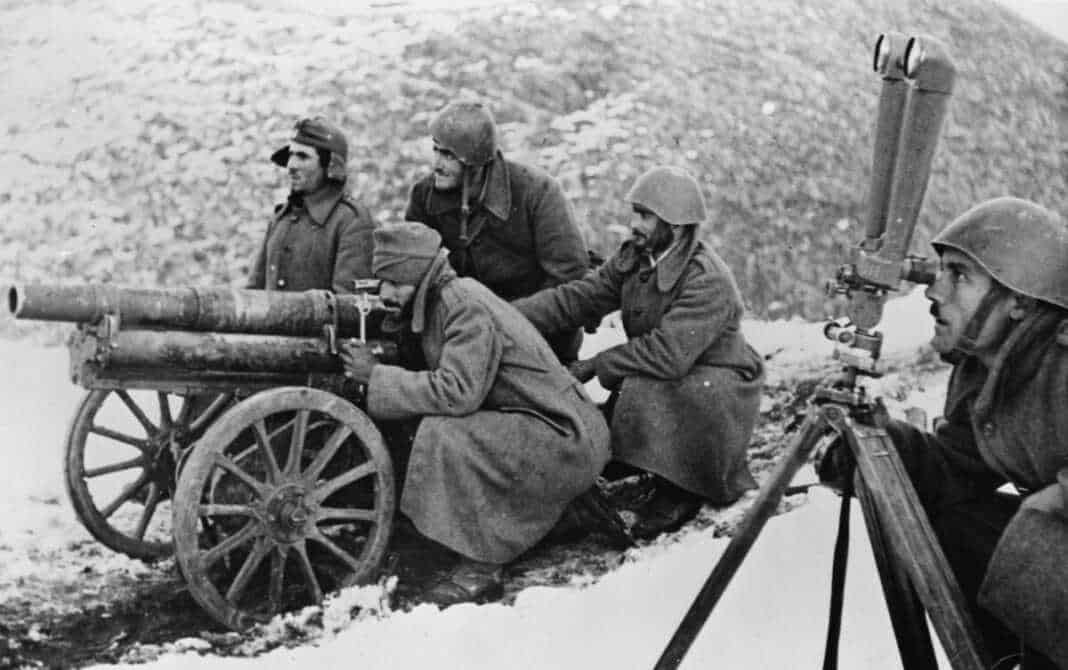
October 28 is our only national anniversary that arose out of a collective fervor and was established as a day of remembrance by the Greek people themselves. In contrast to March 25, which is a «manufactured» anniversary created after the fact, October 28 marks a pivotal event that was, in fact, experienced as a turning point in history. There is no one from the generation of the War and the Occupation who cannot—even today—give a specific answer to the question: «Where were you on October 28, 1940?» It was the birth date of an entire generation. The declaration of war on Italy had an immediate and profound effect on the psychology of the people of that era. More than any previous military conflict (the Balkan Wars, the Asia Minor Campaign), the Greco-Italian War was an experience that permeated Greek society and became intertwined in the collective consciousness of the people with the traditional concepts of justice and patriotism, albeit in a new form: that of anti-fascism.
The Occupation Celebrations
This fermentation took place during the years of the Occupation. Under the Nazi boot, national symbols and rituals began to take on multiple meanings for the numb and disillusioned Greeks. In Athens and the major cities, where the Occupation was most acutely felt, people sought ways to reclaim from the occupiers the right to walk more freely in the streets and to draw inspiration from public spaces and monuments. On October 28, 1941, even as people had already begun to die of starvation, people began spontaneously visiting the Monument to the Unknown Soldier and laying flowers; most of whom were women and girls dressed in black who had likely lost someone on the Albanian front. The first resistance organizations distributed small typewritten leaflets reminding people of the significance of the day, while the EAM (which had been founded just a month earlier) chose that day to issue its first «official» proclamation to the people of Athens, calling for mass resistance against the occupiers.
In 1942, demonstrations, rallies, slogans on walls, arrests, and live fire from the occupiers marked the second and infinitely more militant commemoration, as did the one in 1943. The anniversary had been definitively established as a collective anti-fascist expression. It was not merely a trigger for some vague sense of patriotic pride. Unlike March 25 (which was just as moving, if not more so), this day truly evoked powerful, vivid memories. We can imagine that in 1941, every Athenian longed for the enthusiasm of the crowd that had taken to the streets a year earlier, when the sirens sounded. Amid the fear and gloom imposed by slavery, the memory of that collective surge—like a fantastical replay of an unrepeatable moment of action—served as an inexhaustible wellspring of courage and inspiration. The Resistance against the occupiers did not honor October 28, 1940, as just any moment of exaltation, but as the beginning of a titanic struggle against fascism that had never ceased.
October 28, 1944: An Unknown Anti-Fascist Rally
The fourth anniversary found Greece free. Exactly four years after the deafening sirens of that morning that changed Greek history forever, nothing was the same. The rearguards of the retreating German troops were already at the Greek-Yugoslav border, leaving behind immeasurable destruction, the dead, pain, and tears—but also a massive popular movement that had come of age and been tempered through the Resistance. Athens, now under military rule and home to thousands of martyrs, had enjoyed only 16 days of freedom and was welcoming the Government of National Unity and the first British troops, looking with optimism (and caution) toward the future of the ravaged country. The political situation was tense, and the only common ground among all political forces was their reference to moments that evoked the united resistance against fascism and the duty to honor the fallen of the anti-fascist struggle. As a symbolic message of unity and recognition of an anniversary that had inspired the Greek people during the dark years of enslavement and had been formalized through popular struggles, it was decided to officially celebrate October 28 with a solemn thanksgiving service at the Metropolitan Cathedral and the laying of wreaths at the Tomb of the Unknown Soldier. In addition to the official armed forces that had fought the Germans outside the country’s borders and had been repatriated along with the government —the Middle East Army (represented by a platoon from the Sacred Battalion) and the Navy (with an honor guard)—forces from the Hellenic Police (ELAS) would also be present: A lightly armed detachment of the Athens Hellenic Police from the bloodstained neighborhood of Kaisariani and a unit of the permanent Hellenic Police. It would be the first time in three years that mountain fighters would appear on the streets of the capital, and it was certainly the spectacle that nearly all the people of Athens were waiting to witness.
That morning, the weather was rainy and the thanksgiving service felt subdued. On one side were the country’s official «political leaders»: Prime Minister Georgios Papandreou, Archbishop Damaskinos, the brigadier general and commander of the armed forces in Greece, Brigadier General Ronald Scobie, Eastern Mediterranean Commander Wilson, Admiral Cunningham, Police Chief Angelos Everts, the cabinet, and various politicians. On the other hand, the people: a crowd from all the neighborhoods and workers“ committees of Athens, carrying red banners and placards, cheering and chanting slogans such as ”Death to the traitors“ and ”Democracy«. Lined up in front of the church were the naval honor guard, a platoon of the Sacred Battalion (led by the then-Second Lieutenant and later junta member, Ioannis Ladas), police officers and rural police (in plain clothes) from the Makrygiannis barracks, and a platoon of the Athens Hellenic Police (ELAS) wearing the distinctive German helmets. The crowd was ecstatic, clapping and cheering, taking photos. Most eyes were drawn to a distinct group of 34 fully armed, bearded men standing in the middle of the courtyard, in the »present arms« in the characteristic guerrilla style established by Aris Velouchiotis: the hand holding the rifle by the stock, extended forward. The leadership of the Hellenic Police had ordered the unit closest to Athens, the 34th Attica-Boeotia Regiment, to select the men for this highly honorable mission, and the regiment’s legendary captain, Yannis Alexandrou (»Diamantis«), personally selected the best fighters. They all had beards, cross-strapped ammunition pouches, German weapons, boots, and knives. And one of them, Giorgos Gounaris (‘Artemis’) from Euboea, described in the diary he kept what was perhaps the most moving day of his life up to that point: ‘When we set out, what happened is indescribable!… In vain, [our leader] Apostolis gives orders to march in step. The police are trying to hold the crowd back. They break through the barriers, pour over us, and grab three of us from each row. They’re kissing us, crying… I’m second to last in one of the two rows. They’re lifting us up in their arms, trying to take something as a keepsake, but nothing can be done. Everyone is pulling at us… We’re completely overwhelmed… All we see are heads and waving hands, sending us kisses from afar… A girl in black has hugged me as if she wants me to be hers. I give her a German ring. She’s crying and shouting, ’My little brother!…‘ I give a small German trinket to a woman who’s crying. I toss two handkerchiefs made from flares, and a scramble ensues over who will get them. The others do the same. Finally, the EPON intervenes again, and with them in front and us close behind, we reached the front and took our place in line. The crowd shouts: ’Death to the collaborators! Death to the traitorous murderers!‘ The dignitaries arrived, laid wreaths at the Tomb of the Unknown Soldier, and we presented arms […] The square was packed to the brim; the partisan songs had broken out. Suddenly, our comrade Sarafis, Popov, and five or six others stepped out onto the balcony; they looked at us, smiling, and went back inside. We were singing a song relevant to the Struggle: ’Tonight we’ll lie down on cool grass,’ as well as: ‘So say the cuckoos in the mountains and the partridges on the slopes.’ Also: »You children, children of the resistance, children of Samarina.” Finally, after about an hour of dancing and singing, we said goodbye to everyone [and] got into the car for the return trip. Young men and women are following the car. Crowds of comrades carrying wreaths and flowers are coming from various streets. The young women jump onto the truck bed and hang wreaths around our necks. They hung them on the truck bed with sticks. When we arrived in Aspropyrgos, the participants counted 210 wreaths. A huge pile formed there at the edge of the square…”.
Even though national unity served as a blanket covering the unbridgeable political passions and the accumulated class hatred, there was something special about that day. The shouts of the Athenians that «drowned out» the celebration carried with them an illusion. Hope. Just before parting ways forever, all the Greeks who had fought the Germans found themselves in the same place for a few brief moments to pay their respects to the dead of the Albanian mountains and the thousands who had sacrificed themselves during the Occupation, inspired by the spirit of the front. The date was October 28, 1944, and the rain that had been pouring the previous night had stopped.
*Iassonas Chandrinos is a Ph.D. candidate in Modern History