«Topless Mountains» is the new concept introduced by the Ministry of Environment and Energy and presented today at an online press conference by Minister Kostas Skrekas and Deputy Minister George Amyras, stressing that Greece becomes the first country in Europe to institutionalize «Topless Mountains».
According to the ministers, «Apatity Mountains» is defined as the Roadless Area (RDA) with its one-kilometre perimeter (RDA + 1 km radius).
In these areas, the construction of new roads and other artificial interventions that alter or change the natural environment is prohibited. In addition, they have a high protection status.
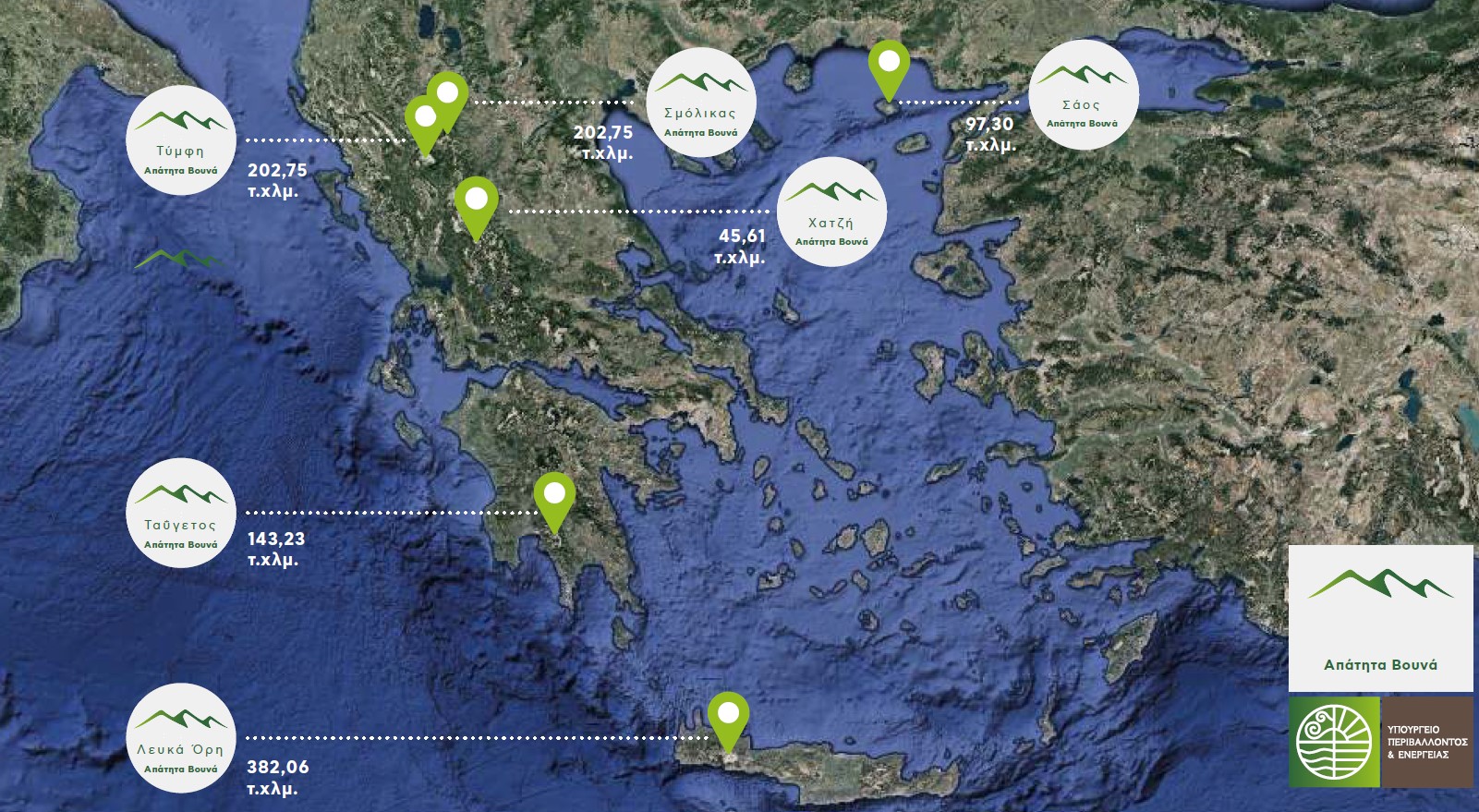
According to what was announced, the permits issued for RES projects are cancelled and the issuance of new permits is prohibited in areas located within the boundaries of six mountain ranges, namely the White Mountains, Taygetos, Smolika and the mountains Tymfi, Saos and Hatzi.
According to what the leadership of the Ministry of Environment and Natural Resources at the press conference on Tuesday afternoon, in these areas will no longer be able to make RES siting, as no artificial surface will be allowed to be created, the permits already issued by RAE are cancelled, while the licensing of proposals already submitted is not proceeding.
According to the ministry, the new strategy is expected to affect some hundreds of megawatts of installed wind power and a small hydroelectric power plant in the Saos, Hatzi and White Mountains and the ban, as stated by the Deputy Minister of Environment and Energy, George Amyras, is legal as it is attributed to reasons of public interest protection.
Which areas will be included in the Apatity Mountains?;
The areas included in the Apatity Mountains are the following:
- White Mountains - Area: 382,06 sq.km. | Altitude: 0-2.453 m.
- Saos - Area: 97,30 sq.km. | Altitude: 0-1.611 m.
- Smolikas - Area: 102,89 sq.km. | Altitude: 782-2.637 m.
- Tymfi - Area: 202,75 sq.km. | Altitude: 460-2.497 m.
- Taygetos - Area: 143,23 sq.km. | Altitude: 432-2.407 m.
- Hatzi - Area: 45,61 sq.km. | Altitude: 598-2.038 m.
As explained by the political leadership of the Ministry, by Ministerial Decision, authorizing article 47 of Law 4685/2020, per region:
- The opening of roads for motor vehicles, the extension of existing roads, regardless of their category, as well as any technical intervention, alteration or modification of the natural environment is prohibited.
- Legally existing works and their maintenance are not affected.
- The marking, repair, maintenance and improvement of existing hiking and trekking trails is allowed, without the use of motorized access means and provided that the interventions are carried out with natural materials.
- Exempted from the conditions and restrictions are projects for national defence purposes, as determined in accordance with the provisions of the applicable legislation.
- Excluded from the above prohibitions are projects and interventions that are implemented due to an emergency (earthquakes, floods, natural disasters, fire, etc.) if care is then taken to restore the environment and projects and interventions that are deemed necessary for reasons of protection and / or restoration of the natural and forest environment.
The «Apatity Mountains» are a brake on the overexploitation of the environment by human activities, but without putting obstacles to investment, as they concern areas untouched by the passage of time.
The presentation here:
Ecotourism can be developed in any area of interest in terms of biodiversity and landscape aesthetics, helping to maintain or create incentives for a transition to green economic activity such as organic farming, promotion of traditional products, etc.
Τa Benefits of the Apatity Mountains
- They contribute to the conservation of natural biodiversity.
- They prevent the entry of non-native species.
- They provide migration routes and stopovers for fauna species.
- They sequester carbon and reduce the impact of greenhouse gases.
- They maintain the connectivity and integrity of the ecosystem.
- They offer recreation, education and scientific knowledge to citizens.
- They regulate and protect ecosystem services: clean water supply, erosion control, healthy soil, air quality, climate regulation, crop pollination, high pest resistance.
What is land fragmentation and what are the consequences?;
Land fragmentation is the breaking up of natural ecosystems into fragments by increasing roads and artificial surfaces.
Fragmentation has direct consequences for:
- Loss, overgrowth and isolation of species' habitats
- Declining populations and local species extinctions
- Degradation of ecological processes
Greece's segmentation rate is half that of Europe, but it is growing faster. Specifically in Greece:
- Greece ranked first in Europe for artificial surface growth (2015)
- Construction sites and roads consume more land in Greece than in Europe.
- The road network in Greece is more than 367,000 km long, while the probability of being more than 1 km from a road is only 5.43%.
What is the relationship between roads and biodiversity loss?;
Roads facilitate the movement of people and goods and are directly linked to boosting economic growth at local and national level.
Despite the significant benefits of having a usable road network, roads are associated with the top five causes of biodiversity loss globally, in descending order of severity:
- The change of land use.
- The direct exploitation of resources.
- Climate change.
- Pollution.
- The invasive species of fauna.
Roads are therefore considered one of the main causes of biodiversity loss and degradation of ecosystem function worldwide, especially when they enter natural ecosystems and formerly undisturbed areas.
Species' habitats are shrinking, populations are becoming isolated, and wildlife mortality from vehicle collisions on the road network is increasing.
At the same time, all ecosystem services associated with soil, such as decomposition or the nitrogen cycle, are lost as the soil is sealed and turned into artificial land.
Indirect impacts on human health are also indirect, by increasing pollution and facilitating the spread of disease.
Why are PADs a matter of global concern? ;
We are living in a time of biodiversity crisis. The sixth mass extinction of species in Earth's history, attributed to anthropogenic causes, has begun, and at least 70% of the earth has been degraded, posing a serious risk to the well-being of humanity.
At the same time, we are also living in a period of peak expansion of artificial surfaces and especially roads.
The length of new paved roads is expected to increase by 59% by 2050.
Leading scientists consider roads to be the worst threat on the planet to biodiversity loss, and therefore the preservation of PAs as the key policy to halt biodiversity loss.
This new trend of conserving PAs has now been embraced by global scientific bodies (SCB, IUCN, UNEP, Conservation International, Tebtebba) and the issue has taken on a global dimension at the UN summits on the Convention on Biological Diversity (COP 11, India and Rio+20, Brazil, 2012).
Does the institution of the «Topless Mountains» exist in the EU?;
Greece becomes the first country in Europe to establish the Apatity Mountains.
The issue of fragmentation of natural land was identified as one of the biggest challenges in the EU in the European Parliament's vote on 08/06/2021 on the new Biodiversity Strategy 2030 «Bringing Nature Back to Life» which took place in early June. Also voted was the obligation to include at least 10% of each country's territory in strict protection status.
The European Commission has put forward a proposal for legally binding targets for the EU's nature recovery in 2021. Restoring the EU's ecosystems will contribute to enhancing biodiversity, mitigating and adapting to climate change and preventing and reducing the impacts of natural disasters.
The main objective of the EU initiative is to restore degraded ecosystems, especially those with the greatest potential:
- Carbon capture and storage.
- Preventing and reducing the impact of natural disasters.
- Soil health and pollination.
- Improving knowledge and monitoring of ecosystems and their services.
With the establishment of the Fraudulent Mountains we are proactively pursuing this restoration policy.
«Roadless Areas», an action that first started to be implemented in 2001 in the USA under the title «The Roadless Rule», are currently being considered by the European Union to be incorporated into the objectives of the Green Agreement.
What climate objectives are the RDPs aligned with?;
The PAs contribute to the achievement of 12 objectives of the National Biodiversity Strategy as set out in:
- Conservation of national natural capital (Objective 2.1).
- Delineation of ecological corridors (objective 3.3).
- Strengthen synergies between key sectoral policies and biodiversity conservation and incentives (Objectives 5.1-5.8).
- Preserving landscape diversity (Objective 6.2).
- Address invasive invasive species (objective 8.2).
In addition, based on the recent National Assessment Report on the United Nations Sustainable Development Goals, the 8 national priorities were defined by the General Secretariat of the Government for the 2030 Agenda.
The demarcation of the extended PADs and their introduction in the country's spatial planning, has been documented to contribute positively to the achievement of three Sustainable Development Goals:
- Responsible consumption and production (Objective 12).
- Climate action (objective 13).
- Life on land, under the 6th national priority under the title: «Enhancing the protection and rational management of natural capital as a basis for social well-being and the transition to a low-carbon economy» (Objective 15).
Finally, the PADs are in line with the European Landscape Convention, as ratified by Greece, according to which the landscape is a «key component of the European natural and cultural heritage».