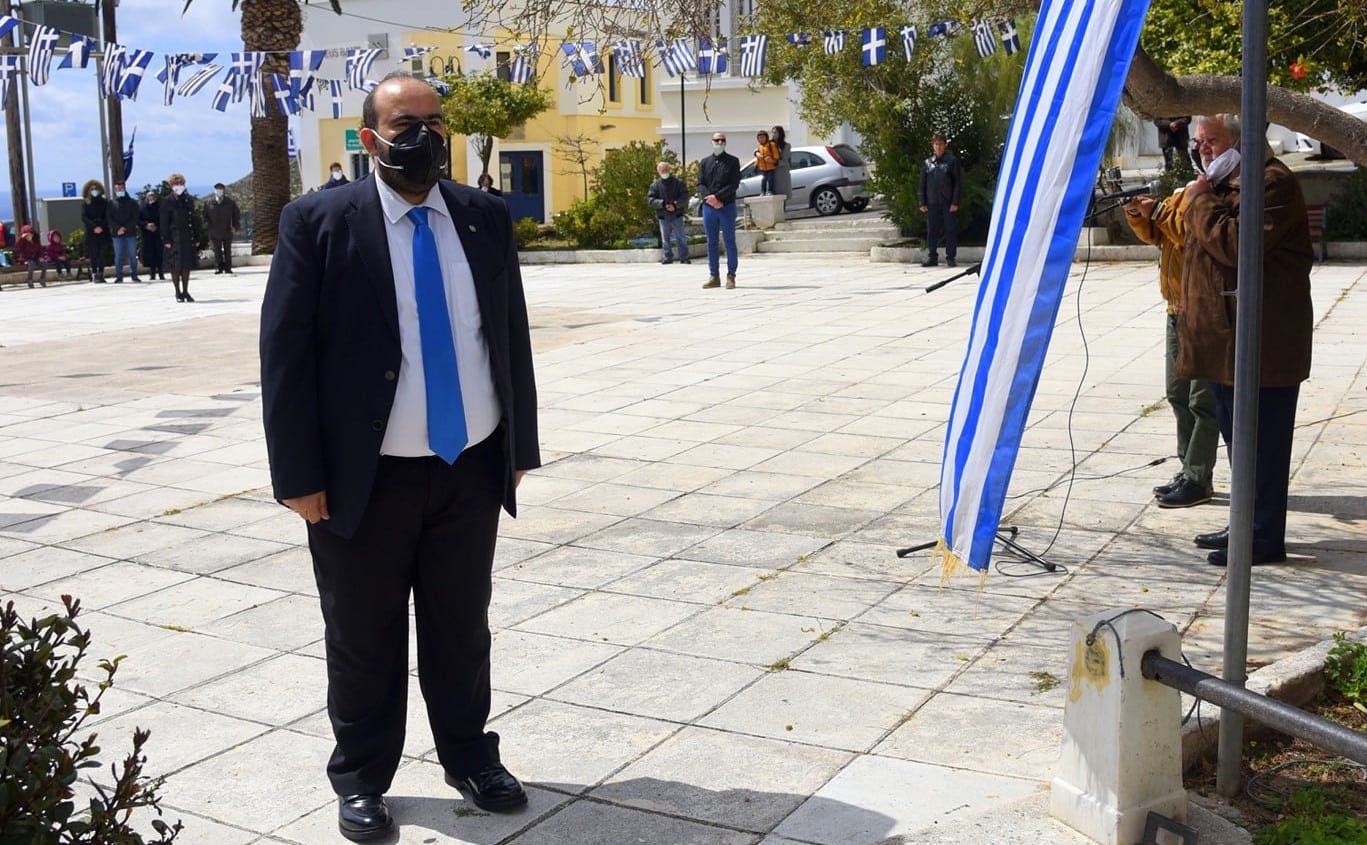
In compliance with the strict restrictive measures due to the coronavirus, the Panhellenic Doxology for the 200th anniversary of the beginning of the Greek Revolution of 1821 was held today at the Metropolitan Holy Church of Chora. This was followed by a prayer at the Memorial of the Fallen in Stai Square and the laying of wreaths. The events were covered by Tsirigo FM, PHOTO CERIGO and Adelinfm Radiofono Kythera.
Ceremonial Speech of the Mayor of Kythera Mr. Efstratios Ath. Harhalakis on the National Anniversary of the 200th anniversary of the beginning of the Greek Revolution, Kythera, 25th March 2021.
It is exactly 200 years today since 25 March 1821, the day that was established as the official day of the Greek Revolution, even though it actually began earlier. And today is a golden opportunity to call a few things by their name, without shying away from the ethnonomenonist and anti-Hellenic contemporary trends that are now seeking our historical, religious and national leveling.
The Revolution of 21 was a unique event not only for Greece but for Europe as a whole. It was not a simple rebellion to regain some kind of autonomy or the granting of certain social rights. It was a universal and universal decision to recover the greatest good of freedom without asterisks, without footnotes, without ‘yes buts«.
There is often dominant - among the tendencies of the ethnonomenonists and professional stateless people - the untruthful view that the then ruling Church stood in the way of the Revolution. The answer to this elaborately constructed myth is provided by the historical texts themselves:
In January 1821, the leader of the Society of Friends, Alexander Ypsilantis, wrote to Theodoros Kolokotronis, who had just arrived in the Peloponnese from the Ionian Islands, who was also initiated into the Society: «The Patriarch, under the Gate, sends you aphorisms and Exarchs, urging you to join the Gate. You, however, consider these to be invalid as they are done by force and dynasty and without the Patriarch's will.» After all, Gregory the E, the Patriarch of the Commonwealth, paid with his own life for his essential support of the Struggle. He was hanged by the Turks on Easter Day, 1821, at the central gate of the Patriarchate, while on 4 May the Bishops of Derka, Gregory of Derka, Dorotheos of Hadrianople, John of Tyrnavos and Joseph of Thessaloniki were beheaded in Constantinople. Dionysios Solomos wrote these shocking verses about the execution of the Patriarch in his Hymn to Freedom:
«All ye who cry, buried
The leader of the Church
Cry, cry, cry hanging
As if he were a killer!
He has his mouth wide open
Hours before he had tasted
The Holy Blood The Holy Body
You say you want to go out again.»
The executions of clergymen are continuous throughout the struggle. On 23 June 1821, the Turks executed 10 Archpriests, 17 Priests and 5 Vatopedin monks, including Archbishop Gerasimos of Crete, at the Great Castle of Crete. On 9 July, Archbishop Cyprian of Cyprus and the Bishops of Paphos, Kition and Kyrenia are executed in Cyprus. The list of executed Archpriests and clergymen is endless. Of course, even within the Church there were opposing views, such as the letter of Patriarch Agathangelos of Chalcedon to the Greeks in 1828, which was duly answered by Kapodistrias himself. However, even these dissonances are not enough to tarnish the wider role of the Church in the national effort to shake off the Turkish yoke. A role that is documented by many texts and sources.
The Society of Friends, the main institution for the organization and preparation of the Revolution, initiated almost all the co-jabis and Metropolitans of the so-called Old Greece into its ranks. One of the first members of the Society of Friends was, according to Nikolaos Spiliadis, the archimandrite Gregorios Dikaios (Papaflessas). Spiliades, who lived the Revolution from the inside, states that the Society of Friends ’already included patriarchs and archpriests and provincial politicians and war leaders«. Even the Marxist historian John Cordatos states: »The Philistines sought to give a nationwide character to the organized revolution and for this purpose they also converted some of the Phanariots and senior clerics«.
All revolutionary texts refer extensively not only to the concept of Patrida, but especially to the fundamental concept of the Orthodox Faith, which is fundamental for the Greeks. Korais himself writes: «Only the teaching of the Gospel can save the autonomy of the Nation. The Greeks fought not only for their country, but also for their faith.
Moreover, the Declaration of the Revolution itself, this leading text of Alexander Ypsilantis published on February 24, 1821, has as its front page the «Battle for Faith and Country» and proclaims: «Turn your eyes, O Compatriots, and see our miserable situation! See here the temples trampled upon! there our children snatched for the use of the insolent sensuality of our barbarian tyrants! our houses stripped bare, our fields plundered and us these miserable andraped! It is time to shake off this unbearable yoke, to free the Fatherland, to break the crescent from the clouds, to raise the sign by which we always win! I say the Cross, and thus avenge the Fatherland, and our Orthodox Faith from the wicked contempt of the wicked. By Union, O Compatriots, by Rebellion to the holy Religion, by submission to the Laws and Generals, by docility and firmness, our victory is certain and inevitable.’ The myth of the supposed opposition of the Church to the Revolution is thus refuted, with numerous examples. After all, what better proof is there than the thousands of new martyrs, clergy and laity, who emerged during the harsh years of slavery and the period of the Revolution? The list of those who gave their lives »for the holy faith of Christ and the freedom of their country« is never-ending.
The great historian Spyridon Trikoupis writes: «For this reason, the Greek Revolution honored human nature above all others. For the most brilliant, the most instructive and the most solemn of all the spectacles that history presents on the stage of the world is the erection of a fallen nation. And the trumpeting of such war is a cherubic hymn to the Most High.
Says Fotakos: «Happy was the day of the revolution of the Greek race, because even then and from time immemorial the nation had the glorious and venerable heir as its guide. These ministers of the true God took care and prepared the nation to rebel, and to change the reverence of its religion and its sacred. The cleric raised the banner of the cross and the nation».
And Makriyannis reproaches those who accuse the clergy and the Church: «...and they curse those who are sold to foreigners, and our priests, where they weigh them anandrus and apolemos. We have had our priests with us in every weather, in every pain and suffering. Not only to call the arms of the holy, but also with rifle and yatagan, fighting like lions. Shame on you Greeks.
And Petrobeis Mavromichalis writes in a letter to Kolokotronis after the triumph at Dervenakia: «Generous general...God is with us as He has conquered many nations and has sent away kings of mighty kings; God Almighty does not leave us to the distinction of the enemy. No, of course not, but he is our ally in all things, as we have said in practice many times, and once in a while by the power of the holy and life-giving Cross and your energy and bravery to destroy the enemy entirely. God forbid, God forbid...».
At the beginning of the Revolution, when the rebels entered Valtetzi, they found it deserted by inhabitants and only a few dead men were lying there. And Fotakos recounts. But Kolokotronis, however, set and gathered their pieces and kept them and said: «These are Saints, they will go to Heaven as martyrs!‘ Then the soldiers shrunk and buried them.’.
The deep faith of the whole troop. In 1826, after the battles of Arachova and Distomo, Georgios Karaiskakis and his army set out to help Athens, which was in danger from Kioutachis. Says the relevant source: «He arrived at the Monastery of St. Seraphim, where his relic is located, a much honored relic by the Rumelians. There Karaiskakis knelt down at the holy tomb nearby, with all his lads, and prayed: ‘Help us, Ayserafeimi, to drive Kikutaya from Athens, to save the shut-in Christians, and to make the Turks second Arachova, and to bring you a golden candle to your tomb and candles a hundred times as big as my body, and to adorn your monastery like a palace!’. And all the army, stripped and kneeling, said the same prayer.».
The first aide-de-camp of Kolokotronis, Fotakos, mentions in his monumental work as an eyewitness of all the events of that time: «The chief priests forgave the priests to read in the churches night and day the prayers to God to strengthen the Greeks in the future struggle. [...] they forgave them to exhort the Greeks in their confessions to the revolution, and to consider it as religiously forgiven, because God made all men free. Many not even of the high priests, as Elus Anthimos, made deliberate wishes, which they gave to the priests of their provinces and recited after the paraclete.».
Like every national liberation struggle, the Greek Revolution did not walk on a road paved with rose petals. The problems it faced from the outset were enormous. The financing of the struggle, the competition for political office between factions and individuals, the terrible civil war - the great curse of our race - were just some of the challenges that the then revolutionary homeland had to face. But none of these can diminish or override the brilliant final result, which was the liberation of the country and the creation - through both politics and diplomacy - of the first independent Greek State in modern history. It was a wondrous achievement. It was something that few had believed from the beginning. It was a result of many factors and circumstances that gave rise to the gradual dissolution of the hitherto powerful Ottoman Empire.
There are many myths about 1821. On both sides. The texts, however, are the most irrefutable witnesses to the actual events. The cleansing of history from myths is as necessary today as ever, after all, our National Poet himself calls on us «to consider as national what is true». But it is one thing to dispel myths and historical misconceptions, and quite another to dispel the nihilism and flattening that unfortunately prevail in our time.
The tendency towards levelling and ethnonationalism, the promotion of the idea of the «universal homeland» which has no history, boundaries, borders and limitations, the view that national symbols are no longer meaningful and constitute anachronism, is the most dangerous and damaging for the future of the country. On the occasion of the 200th anniversary of 1821, we must erect an unbreakable wall against all these views, which are nothing new, but are part of a general trend of moral and national deconstruction of our society. From the abolition of polytonism to the deletion of the word «national» from the official title of the Ministry of National Education in 2009, we have seen a sequence of actions and events that contribute to a predetermined effort of levelling and national apathy.
On the abolition of polytonism, Christos Giannaras writes: «the imposition of the monotonic is in the history of the Greeks a catastrophe, incomparably more devastating than the Asia Minor. In the Asia Minor Catastrophe, ancient cradles of Hellenism were lost, its cosmopolitan nobility was lost, the consciousness that Hellenism is a civilization, that is, a «way» of life, not a citizenship of Balkan provincialism. But the continuity of its language, which is also the practical continuity of its historical consciousness, the continuity of the Greek «way» embodied in the written word, was not lost. The monotonic abolished the notation that linked the ancient Greek phonetic «prosody» with its written expression and made the Greek language unified from Homer to the present day».
On the importance of Education, Tercetis mentions the following incident with Kolokotronis: «Kolokotronis one day in his house in Athens, was playing in the chamber while his child Kolinos was writing. He stopped at once and asked him: ‘Kulinis, which do you think is the national house of Greece?’ Kolinos answered him at once: ‘The King's palace’. ‘The King's palace? ’No!» he said. 'The University!'".
The leveling and nihilism, the attempt to eliminate the Faith from the Homeland (in complete contradiction to the teachings of 21) continue: the Cross has been removed from the official symbol of the celebration of 200 years! The painting of Vryzakis with the Old Patron Germanos of Patras blessing the revolutionary flag was recently defaced and few have reacted! The busts of the Heroes on the Field of Areos and elsewhere are daily desecrated by the hands of young people! The Greek flag is surrendered to mockery! And worst of all: some people justify and encourage these acts in the name of a supposed democracy and a vague rightism. If now, if in the 200 years after 21, we do not shout a thunderous «HOSH HERE!» to every such practice, then we will indeed be worthy of our fate! And worst of all, the disastrous under-birth rate, which is leading Hellenism to extinction with mathematical precision. We hear every day about «development policies» and «progress projects» but we hear nothing about effectively addressing the number one national danger, which is under-birth rate.
Today, 200 years after 1821, we are all called upon to take stock of these two centuries of national independence and freedom. And there is no doubt that the scales are tipped in our favour. During these 200 years, our country has grown in terms of territory and population, fought the Axis with heroism, acquired modern infrastructure, became a member of the great European family, gave birth to Saints and Heroes, created great personalities of letters, sciences, arts and politics, matured and consolidated the institutions of democracy and parliamentarianism. But it also experienced moments of national tragedy. In ‘22 in Smyrna, in ‘74 in Cyprus, the Civil War and the National Schism. But she never ceased to reflect on the immense importance of the 1821 Struggle for her modern national consciousness.
The unprecedented conditions we are living in due to the pandemic do not allow us to celebrate 25 March with the appropriate pomp and splendour, while at the same time thousands of citizens are allowed to march with an unthinkable tolerance in support of an unrepentant convicted murderer. In a few years, however, on 3 February 2030, we will celebrate another anniversary, a direct offshoot of the present one: the 200th anniversary of the official establishment of the first independent Greek State, created by the Protocol of London on 3 February 1830. So we have exactly 9 years to go until then. In that time we must change our country for the better. Eliminate ethnonationalism and levelling, ensure that our children are taught and speak proper Greek, that the desecration of symbols, flags, heroes and saints will NOT be a right and will not be surrounded by any kind of ideological justification, that the term «national» will return to the title of the Ministry of Education as it is in France, Luxembourg, Poland, Romania and dozens of other countries of the world that respect themselves, their history and their culture; that our country will finally address the national problem of under-age births with seriousness and responsibility in order to continue to exist; that our country will finally address the national problem of under-age births with seriousness and responsibility in order to continue to exist.
And further, to have fought our persistent vices. Says Professor Veremis: «One of them concerns the relationship between the citizen and the state. One of one of them is that of the citizen, one of which is the relationship between the citizen and the state. One of the problems of the citizen is the relationship between the state and the citizen. In our minds the state has always remained a potential enemy. When it hands out money, it can also become a friend. The English understand their relationship with the state differently. The tradition of the thieves» torpedoes still works. Inside us we have a thief-torturer who wants to go out and manifest himself.« And when the Professor is asked »finally, should we celebrate 200 years with our heads held high?« he replies: »Of course we celebrate. But also to learn. If we do not fight our ills we will not move forward. Celebrating 200 years with a lot of brains".
200 years after 1821. Should we be proud? YES! Should we worry about the future? YES! Because nothing is a given, nothing remains stable if we ourselves do not safeguard all our national acquisitions and rights on a daily basis. If we want our Nation to continue to exist then we must invest in Education, National Education, which is the only democratic path through which the phenomena of ethnonationalism and flattening will be gradually eliminated. Yes, we are citizens of the world, but above all we are Greeks and we will not be ashamed to proclaim it, nor will we be afraid to make our Cross outside the Churches, nor will we be timid in honouring our Flag and our National Symbols!
Heading towards 2030, towards the 200th anniversary of the official independence of Greece, let us take as a legacy the wise words of Kolokotronis, as he said in his speech at Pnyx in November 1838, addressed to the young people of the time. He focused on three lessons: the avoidance of discord, the preservation of the Orthodox Faith and the acquisition of Education. Let us listen to him:
«My children!
In this place, where I go this day, men of old time praised and expounded, and men of wisdom, and men with whom I am not worthy to compare, nor to reach their footsteps. I have desired to see you, my children, in the great glory of our forefathers, and I come to tell you what I myself have witnessed in the time of the struggle, and before and after it, and from these things we may also draw conclusions for your future happiness, though God alone knows the things to come.
In the first year of the Revolution we had great unanimity and all were in agreement. One of us went to war, his brother brought wood, his wife cooked, his child baked bread and gunpowder in the camp, and if this unanimity had lasted two more years, we would have conquered Thessaly and Macedonia, and perhaps even reached Constantinople. So much did we frighten the Turks, who heard a Greek and fled a thousand miles away. A hundred Greeks put five thousand in front, and a ship a tank. But it did not pass!
When many command, the house is never built nor finished, but there must be an architect, who commands that it be built. Likewise we also need a leader and an architect, who commands and others obey and follow. But because we are in such a state, because of discord, Turkey has fallen upon us and we are about to perish, and in the last seven years we have not accomplished great things.
In this situation the king comes, things are quiet and trade and agriculture and the arts begin to progress and even education. This learning will increase and make us happy.
You must guard your faith and strengthen it, for when we attacked the chariots we said first for faith and then for country.
I, my children, by my bad luck, because of circumstances, have remained illiterate, and for this I ask your forgiveness, because I do not speak as your teachers do. I have told you what I myself have seen, heard, and known, that you may profit by the despised and evil effects of discord, which you should turn away from, and have concord. O us no more. Our work and our time is past. And the days of the generation that paved the way for you shall soon pass away. The day of our life shall be succeeded by the night of our death, as the day of the Holy Ghosts shall be succeeded by the night and the morrow. It remains for you to straighten and adorn the place where we have made free; and to do this, you must have as the foundations of the state unanimity, religion, and wise liberty.’.
I DEMAND THE NATION!
I DEMAND the 25th of March 1821!
ETERNAL MEMORY OF THE HEROES AND FIGHTERS OF ‘ 21!